
|
|
|
#1
 06-29-2014, 02:52 PM
|
||||
|
||||
|
DuMont 12JP4 CRT observations
Looking at two different DuMont 12JP4 CRTs I have, there are some obvious differences in the envelope construction. I'm curious how prevalent the two styles are. In some ways it's surprising that two tubes with such differences have the same number, without even a suffix change.
The one on the left is from a DuMont RA-103 Doghouse, and the one on the right is from a Crosely 9-407 (RA-103 clone). Note that the original etched DuMont labels are more or less identical. Here's the tube without the bulge (the one on the left above): Here's the one with the bulge (the one on the right in the image above): Not only do the two tubes have slightly different overall length, but the yoke position between the two is slightly different, which is clearer to see via the red reference lines I added to the picture. Both the Crosley and DuMont chassis (which look identical to me) have two sets of mounting holes for the yoke, which I suspect is to allow for the slightly different lengths and yoke positions of these two tubes: You can see in the above picture that the yoke could be moved forward to a new sets of mounting holes that is visible, in addition to being able to slide the yoke back and forth a little for each set of holes. I think the one on the right is a Pyrex tube, while the one on the left may be soft glass. The one on the left is heavier, and appears to have somewhat thicker glass, at least on the front face. Which of these two types do the rest of you see in your DuMont and DuMont clone sets? 
|
|
#2
06-29-2014, 03:49 PM
|
||||
|
||||
|
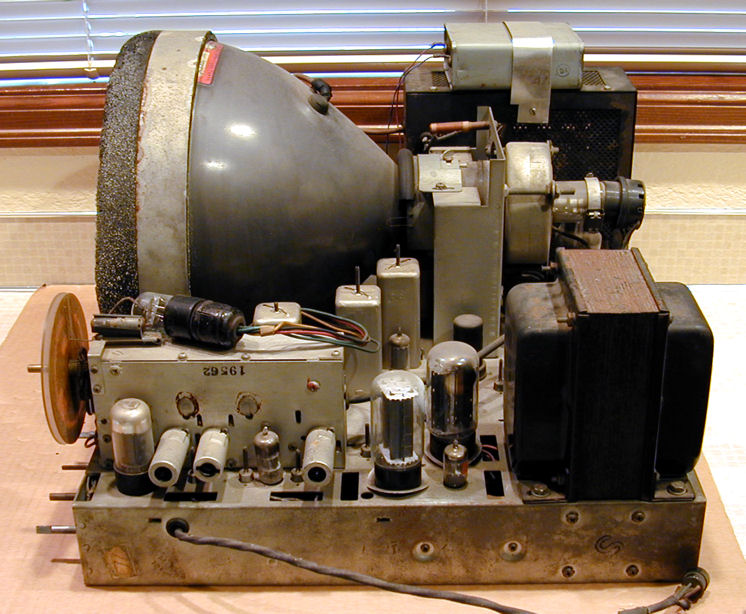
In this pre-restoration photo, it looks like my RA-103 (console) has the same type of tube as your RA-103 doghouse (i.e., without the bulge at the neck):
 My yoke mount has a pair of adjustment slots instead of two pairs of holes: 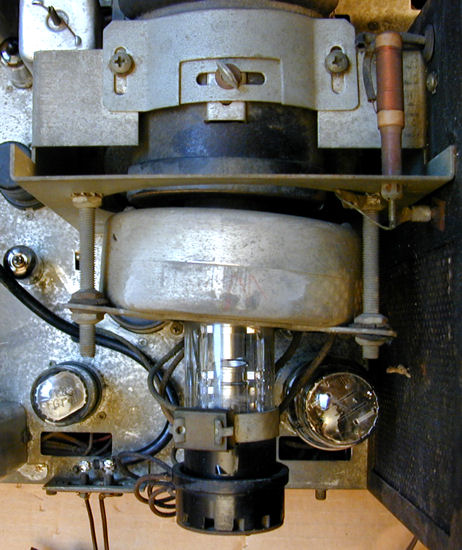 My mount is pushed nearly all of the way back; I wonder if it could even accommodate the bulge-style CRT. Phil Nelson Phil's Old Radios http://antiqueradio.org/index.html
|
|
#3
06-29-2014, 04:03 PM
|
||||
|
||||
|
I'm wondering if the radius of curvature of the faceplate surface is the same in both tubes. The older style may be blown rather than molded and bulge out more in front in the center, but actually have about the same distance to the yoke when mounted up to a mask.
 jr
|
|
#4
06-29-2014, 04:03 PM
|
||||
|
||||
|
Phil are you sure that's a 12JP4 and not a 12LP4, JP4 shouldn't have an ion trap.
|
|
#5
06-29-2014, 04:29 PM
|
||||
|
||||
|
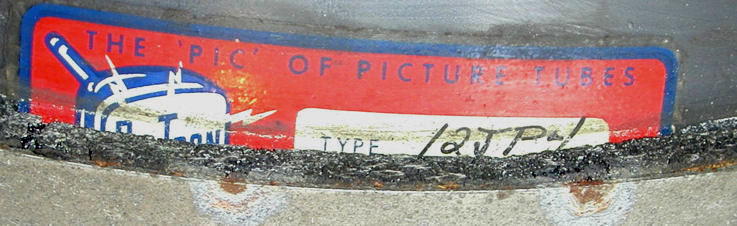
Well, the rebuild sticker on the CRT said 12JP4, but looking back at my article, I guess the consensus was that the rebuilder had substituted a different gun, hence the ion trap magnet.
 Phil Nelson
|
| Audiokarma |
|
#6
06-29-2014, 05:13 PM
|
||||
|
||||
|
Quote:
The JP4's in the few sets I've had or worked on seemed like Pyrex, thin glass all around, even on the faceplate, almost seemed like a pre war type. I currently have only one Crosley with a Dumont chassis and CRT, I think it's a thinwall tube but I don't recall if it had a bulge or not, maybe I have a picture of it saved somewhere. Other post war tubes I've seen like that are the 7JP4 electrostatics and the 9QP4 used in the little 1956 GE Portables. The original and early Dumont tubes used a weird gun, it was odd in some way but I can't remember exactly how, didn't look much like the one in the 10BP4 etc, most of them have an ion burn in the center also.
|
|
#7
06-29-2014, 05:16 PM
|
|||
|
|||
|
It is known that Dumont had different envelopes for one of their 15" tubes with the same number.
I recently had a Dumont 12qp4 with a different anode connector than the Dumont ball -- it had the 12lp4 type cup. It was an etched Dumont but was a rebuild. I think the yoke mount in both pics shown has 2 sets of mounting holes, with slot.
|
|
#8
06-29-2014, 05:52 PM
|
||||
|
||||
|
The Tung-Sol spec sheet shows both outline shapes but the same overall length.
http://frank.pocnet.net/sheets/127/1/12JP4.pdf'
__________________
Tim
|
|
#9
06-29-2014, 08:33 PM
|
||||
|
||||
|
Notice the two bulb shapes in this Tung-Sol data sheet:
http://scottbecker.net/tube/sheets/127/1/12JP4.pdf
|
|
#10
06-29-2014, 11:17 PM
|
||||
|
||||
|
The dimensional tolerances are pretty wide (+/- 1/4" for most; +/- 1/2" for the yoke point on the neck), so the fact that one of my tubes is longer than the other and has a slightly different yoke position may not be significant. That's probably also why the yoke mount on the chassis has quite a wide range of adjustment. The +/- 1/2" tolerance requires a full inch of adjustability to handle the range of what could be expected with different CRTs.
|
| Audiokarma |
|
#11
06-29-2014, 11:41 PM
|
||||
|
||||
|
Mine has a trap and its a 12JP4....
SR
|
|
#12
06-30-2014, 07:44 PM
|
||||
|
||||
|
Tom, my RA-103 has a 12JP4, did not have a trap, and matches your right hand tube above. Here is a picture of it before restoration.
Dave Last edited by Zenith6S321; 02-22-2015 at 06:54 PM.
|
 |
|
|


 Linear Mode

