
|
|
|
#1
 09-25-2010, 04:35 AM
|
||||
|
||||
|
Old voltages in Europe
I'm curios, in Europe, in the past, besides 220, 230, 240 Volts what other voltages there where used. In Germany there where ever used 110 V?
In former U.S.S.R they once used 127 V. BUt who in Europe used 150, 180, 200 Volts? Romania was the land of variety. Due to the facts that some areas of Romania wheren't Romanian up to 1918 and that there was no general electrifcation plan up to 1950 you could found a variety of voltages and even 2 frequncyes (in fact, at Resiţa (Reshitza) metalurgical and machines Plant you could find up to the '30's or '40's even a 3rd frequency, 20.8 Hz). The trend was to generalize the 380/220 V voltages and the 50 Hz frequency (this trend apeared in the '30's). But since Romania was a poor country *, this trend spread only into big cityes (except for Bucharest, where the indtroduced 380/220 V in the '50's, so up to the 1974-1975 you could find areas with 208/120 V). In Romania, before the Communist regime started the 10 yrs eletctrification plan (1950-1960) (b.t.w., there are still some remote areas with no electricity), you could find the next voltages and freqeunyces. - 380/220 V 50 Hz. Ploeşti ** (Ploieşti) (except the center of the city) and Prahova county (Ploieşti is the amdinistrative city of Prahova county); City of Braşov and Braşov county, Arad and Arad county, City of Iaşi etc - 380/220 V 42 Hz. City of Timişoara (they where planning even before 1950 to introduced 50 Hz, but W.W. 2 camed) - 208/120 V 50 Hz Bucharest and sourinding areas - 220 V d.c. center of Ploieşti and other ares in the country - 150 V d.c. - 110 & 120 V d.c. * for eg, even in Bucharest not all of the city was electrified (around of it 50-60% was electrified) because people hand't had money to connect theyr house to electricity network and money to pay the wires and the wire installation. Except for the today's Ilfov county (the old Ilfov county was bigger) - the county sorounding Bucharest which was electrifed in a 50-80% proportion, and the countyes of Prahova, Braşov (Brashov) and Sibiu where about the proportion of ruralar electrification was from 20 up to 30 procent (the biggest one was in Sibiu County), other countyes had less then 20% of the villages electrified. ** up to 1949 the city was called Ploeşti, not Ploeişti. This topic might be an off-topic therad, but I don't think Europeanen members are going to the off-topic area! 
|
|
#2
09-25-2010, 04:41 PM
|
||||
|
||||
|
Here in Italy, before the nationalization of the electric distribution network in the mid 60s, we had 3 voltages: 125, 160 and 220v 50 Hz, some rural areas also had DC power systems based on small hydro plants, usually 48 or 125 Vdc
also some homes were supplied with both 160 and 220v (160 for lighting, 220v for appliances) as they were derived from the same 220v 3-phase system Due to this, most of our vintage electronics have a voltage selector with at least three selectable voltages: 125-160-220v Even the smallest cheapest tube radios always have a built in autotransformer to allow for different voltages. Today we mostly have 220v single phase and 380v 3-phase athough some areas have already moved to the new European standard of 230v single phase and 400v 3-phase
|
|
#3
09-25-2010, 04:46 PM
|
||||
|
||||
|
Spain had 125 and 220, 125 was in older houses. Little by little they changed over to 220. Also they had the concept of "luz" and "fuerza" in some homes. Luz was the lighting circuit, and fuerza (force) was for heavier using appliances, like water heaters, washers, TV's, electric heaters, etc., metered separately. Now everything, I think, is 220 / 50 Hz.
__________________
Reece Perfection is hard to reach with a screwdriver.
|
|
#4
09-25-2010, 06:08 PM
|
||||
|
||||
|
Luz means light/lighting in Spanish, no?
Kiwick: when the introduction of 220 V was finished in Italy?
|
|
#5
09-25-2010, 07:15 PM
|
|||
|
|||
|
In north America the electrical system has been standardized for only the last 50 years or less. In the large U.S. cities the downtown districts were D.C. to accomodate elevators. Rather than having two power sources ,they used D.C. for everthing. Also there was different odd frequencys such as 25,40 and 50 hertz.
|
| Audiokarma |
|
#6
09-25-2010, 08:45 PM
|
||||
|
||||
|
My old boss came from Germany and was a teenager during World War II. He said some soldiers (I am not sure which ones) would unknowingly take AC-powered radios into the DC power areas and burn out the transformer. He made a little money repairing these sets.
|
|
#7
09-29-2010, 05:19 PM
|
||||
|
||||
|
Quote:
|
|
#8
09-30-2010, 01:06 PM
|
||||
|
||||
|
My wife's family lived in a huge three-story house built in the thirteenth century in Barcelona, and the electric service was from not long after that, it would seem! In the 1960's and 70's, they still had 125 volts, served from a tiny black ancient meter with a big knife switch and a couple of porcelain fuse holders, all arranged Frankenstine-style on an open board in a back hallway. Come nighttime, lights would be turned on little by little all over the house. Then there would come a loud buzzing and my father-in-law in the living room would holler out "El contador!!" and we'd rush around turning out some of the lights to quiet down the little old electric meter, which could have burned out from the overload. Abuelo didn't want to change the service to 220 because he'd have to change out all the appliances. The screw-in plug fuses had removeable screw-off covers and a couple of screw terminals inside. You could buy lead wire like solder and "renew" the fuses by cutting a piece of wire and attaching across the terminals. What he used instead was a couple of strands of fine copper wire. The fuses would get so hot you couldn't touch them, but no matter, everything was porcelain and could take it! With the voltage drop sometimes you could just sense the 50 Hz pulsations in the lights.
__________________
Reece Perfection is hard to reach with a screwdriver.
|
|
#9
09-30-2010, 05:54 PM
|
||||
|
||||
|
Back in New York City in the 60's parts of the subway system lighting was run on 25Hz power; you could see the 50Hz flicker (bulbs would pulse with light twice per cycle).
Today most houses in the USA are fed 240VAC 60Hz centertapped, to yield a pair of 120V supplies for small loads like TVs, radios, lights and such, and 240V for the bigger stuff like dryers, electric ovens and stoves, water heaters and central air conditioners. I have a few 240V 15A outlets in the house to feed my Australian and European radios that want 220V. 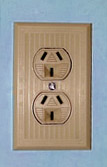 They don't mind the 60Hz instead of 50Hz, turns out transformers for 50Hz are happier on 60Hz, as the cores need not be as large as needed for 50Hz. . A few places get 2 of 3 phase 120V Y system, to give 208V across the hots. They don't mind the 60Hz instead of 50Hz, turns out transformers for 50Hz are happier on 60Hz, as the cores need not be as large as needed for 50Hz. . A few places get 2 of 3 phase 120V Y system, to give 208V across the hots.
__________________

|
|
#10
10-02-2010, 06:57 PM
|
||||
|
||||
|
B.t.w, there are in U.S.A electric engines or stuff runing at 208 V? In Bucharest we had 3phase 208 V (when we used 120 V in stad of 220 V).
|
| Audiokarma |
|
#11
10-02-2010, 11:06 PM
|
||||
|
||||
|
Quote:
The US is 60Hz, but parts of Los Angeles were 50hz, and parts of upstate NY were 25hz at one time. DC power was common in cities, though most paces were converted to AC. Con Ed had DC in NYC until recently though, for industrial loads. Amtrak, Septa, and parts of NJ Transit, are still 25hz at the contact wire, with the signaling system being 100Hz or 92.something Hz. I think 100Hz for signaling is standard in 60hz power regions. Standard industrial voltage in the US is 480 volts. Almost all homes have 240 volt service in the US, along with 120. It's center tapped and 120V loads are balanced between the sides of the center tap. Outlets are 120 volt, which can mean just about anything in the US these days... It's supposed to really be 117 volt, but can be anywhere from 110 to 125 in reality. Unless you live in the territory of a certain power authority east of NYC, in which case the voltage service they give you is just a suggestion... Frequency stability in the US, however, is pretty darn good - it rarely deviates from 60hz, by more than a fraction of a Hz.
|
|
#12
10-03-2010, 02:16 AM
|
||||
|
||||
|
Quote:
 Or so it seemed when I was there occasionally in the mid 1990s. Or so it seemed when I was there occasionally in the mid 1990s.Coming back to Europe, or specifically the UK. We had a wide variety of voltages and frequencies as local generators were free to choose. Then came the national grid in the 1930s which forced the frequency to be standardised at 50Hz. Don't know why 50Hz but that's what was chosen. I think the voltage was standardised at 240V at the same time. I know that DC mains were available in the City of London up to the late 1960s. Used for DC motors on lifts etc.
|
|
#13
10-03-2010, 09:42 AM
|
||||
|
||||
|
Quote:
Quote:
UK power is weird - ring buses, a switch at every outlet, plugs the size of a US dryer plug... BTW, the US isn't a single grid, it's 3 - east of Rockies, west of Rockies, and Texas. There may be some DC interties between them. We 'share' power from Canada, too. In other words, they feed NYC, we feed them money 
|
|
#14
10-04-2010, 01:00 AM
|
||||
|
||||
|
Quote:
We can also connect a washer, dryer, electric kettle etc to a standard outlet in the UK Quote:
|
|
#15
10-04-2010, 01:47 AM
|
||||
|
||||
|
Quote:
 We also didn't lose power in this town back in 1965 or so when that big power failure hit the Northeast, seems whoever was running the local power company's system didn't like the way the meters were kicking and disconnected from the network before it died. . We also didn't lose power in this town back in 1965 or so when that big power failure hit the Northeast, seems whoever was running the local power company's system didn't like the way the meters were kicking and disconnected from the network before it died. .
__________________
|
| Audiokarma |
 |
|
|


 Linear Mode

