
|
|
|
#1
 07-27-2021, 11:56 AM
|
|||
|
|||
|
What is the theory behind low voltage focus CRTs?
What is the theory behind how low voltage focus CRTs work, and how does that compare and contrast to the high voltage focus CRTs?
I know that in both low voltage focus and high voltage focus CRTs, the G1 control grid uses a low voltage (relative to the cathodes) to force the cathode ray to squeeze through the G1 control grid's aperture, which in a CRT is a metal cylinder surrounding the cathode with a small aperture at the exiting end. This is an example of how low voltage can be used to make the cathode ray a thinner, sharper beam. Do low voltage focus CRTs use a similar mechanism? What are good articles to read on this topic? 
|
|
#2
07-27-2021, 01:36 PM
|
||||
|
||||
|
It's an electron beam optics question. The focusing electrode acts and a lense for electron beam.
You'd probably want to find a book on CRT design to read up on it (I'm not familiar with any). The low focus voltage guns tend to loose the ability to reach optimal focus as they age.
__________________
Tom C. Zenith: The quality stays in EVEN after the name falls off! What I want. --> http://www.videokarma.org/showpost.p...62&postcount=4
|
|
#3
07-27-2021, 02:07 PM
|
||||
|
||||
|
Perhaps search for info on Einzel lens design such as this:
https://s3.cern.ch/inspire-prod-file...6fa56930f1de08 jr
|
|
#4
07-27-2021, 03:07 PM
|
|||
|
|||
|
Quote:
The reason why I am interested is to better understand how to tune a TV's sharpness and focus. I've experimented with modding a 1990s TV so that the G1 anode's DC bias can be adjusted. Based off of my experiments, I found that I was able to obtain a sharper and thinner cathode ray by adjusting the G1 DC bias, in addition to the DC bias of G2 and G3. Due to the G1 anode's shape, this is analogous to adjusting how open vs closed an optical aperture is, and can be used to make the cathode ray more sharp and thin. By separately adjusting the DC bias of the G1 anode, a sharper picture is possible than what can be obtained by adjusting the G3 focus voltage alone. Here are examples of 240p video content before/after the mod (left before, right after):   The GE Portacolor is my first color non-solid state TV, and unlike 1990s TVs, it has pots galore for controlling DC bias of: cathodes, G1 grids, G2 screens, and G3 focus... well, not a pot in my early Portacolor, but I can mod it to add a pot for controlling the DC bias of the G3 focus anode.  While many people understand that changing the DC bias of the G1 will change brightness, I've found that most people do not understand that it also changes the thickness and sharpness of the cathode ray. This is actually important information for TV collectors because most service manuals, Photofacts, and schematics just refer to the DC bias of these cathodes and anodes as "brightness" pots. It is important to distinguish between "brightness" as in "black levels" versus cathode ray "thickness/sharpness". It is possible to calibrate DC biases to have proper black levels and a thick and dull cathode ray, where the picture looks less sharp, but it is also possible to calibrate the DC biases to have proper black levels and a thin and sharp cathode ray, where the picture looks more sharp. Again, this is in addition to tuning the DC bias of the G3 focus anode. I am going to experiment with modifying this GE Portacolor I got to add a pot for controlling the red cathode's DC bias (it already has pots for the other two cathodes), and also add a pot for controlling the G3 focus anode's DC bias (apparently the early Portacolors lack a pot for this, likely as a cost cutting measure). My hypothesis is that I will get the thinnest, sharpest cathode ray with the following calibration:
The Portacolor's very bad mask dot pitch will definitely limit what is possible. If the cathode ray is too thin and sharp, the moire effect will be very bad.
|
|
#5
07-27-2021, 03:09 PM
|
||||
|
||||
|
As far as I know they work the same as Hi focus.
I would guess its just easier = cheaper that way. On the US side most MFGS sold a 14" probably all with the RCA jug. RCA also had a 19" low focus, Zenith 14" & 16". Most used taps & a few a control to adjust. After a few years you usually didnt see a difference adjusting them unless the CRT was VERY strong. From Japan TONS of them were sold through Sears. Mostly Toshibas & Sanyos. They looked even worse but on the test jig not so bad at all after you put a hand full of low level tubes in them. 73 Zeno  LFOD !
|
| Audiokarma |
|
#6
07-27-2021, 04:25 PM
|
|||
|
|||
|
Quote:
I have a theory as to why high voltage focus became more popular than low voltage focus. The high voltage focus has both a lensing effect to focus the cathode ray into a tighter beam, AND it also has an acceleration effect due to a high increase in voltage in the direction leading towards the face of the CRT. The faster electrons move towards the face of the CRT, the less time they have to spread outwards from the center of the cathode ray. This, btw, is one reason why a low ultor voltage causes the picture to be blurry compared to a high ultor voltage. Less acceleration from the ultor anode gives the electrons more time to spread out. The low voltage focus designs, assuming they are a true Einzel lens, only focus the cathode ray, they do not change its acceleration along the axis perpendicular to the face of the CRT like a high voltage focus design does. This theory would help explain why low voltage focus CRTs had a reputation of being both less sharp than high voltage focus CRTs AND a reputation for not aging as well when it comes to losing ability to focus a sharp picture. Side note: vintage television is fun because it gives you an excuse to play around with a particle accelerator. Yes, a CRT meets the scientific definition of a particle accelerator. 
|
|
#7
07-27-2021, 08:13 PM
|
|||
|
|||
|
I spent a few hours reading research papers, articles, and patents on electrostatic lensing and especially on Einzel lenses (commonly referred to as low voltage focus) and bi-potential lenses (commonly referred to as high voltage focus).
First, the National Valve museum has scanned a great series of articles from 1950s thru 1960s that explain the basic nature of electrostatic lensing. The physical phenomenon is explained in this figure which shows the cross section of two conductors shaped as hollow cylinders with a vacuum gap between the two cylinders: 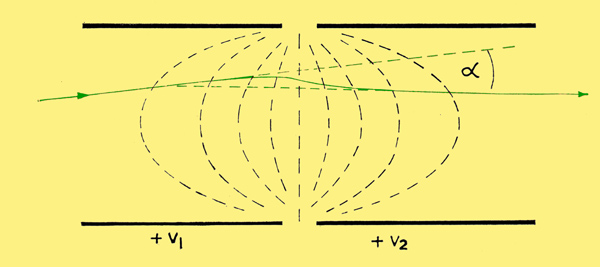 Whenever two cylinders are arranged in this manner and the difference in voltage between the two is non-zero, an electrostatic field is created as depicted by the equipotential lines. The lens is formed in the gap between the two cylinders, and its effect on the path of a cathode ray (green line) is analogous to the effect that a glass lens has on the path of a ray of light. The power of the lens corresponds to the magnitude of the difference in the voltage of the two adjacent cylinders. This patent from Intel has a great one page introduction on different CRT focusing designs. It also describes how to use the G1 anode as an iris: Quote:
 The patent goes on to describe a standard low voltage Einzel lens using the following diagram. Cylinder 20 in the figure is what televisions connect to the "focus" voltage. Cylinders 16 and 22 are connected via jumper 24 so they both have the same voltage, and they are then connected to the ultor anode using snubber springs 30. The gap between cylinder 16 and 20 forms a lens, and the gap between cylinder 20 and 22 also forms an identical power and shaped lens. This brings me back to the goal of maximizing the sharpness of the GE Portacolor. According to Einzel lens theory, the following DC bias settings will create the smallest iris opening and maximize the power of each electrostatic lens:
This voltage setting will likely have black levels that are incorrect. So starting from those "max lens power" voltages, if brightness is too high, I will lower G2 voltage until brightness is correct. Otherwise, if brightness is too low, I will raise G1 until brightness is correct. The electrostatic lens theory stats that as lens power is increased, spherical aberration is also increased. This is why increasing the G3 focus voltage above ground potential may be necessary for maximal sharpness. So the final step for calibrating the GE Portacolor's sharpness is to, starting at zero volts, increase the voltage of the G3 anode until the picture has maximal sharpness. Doing this will require modifying the GE Portacolor to add 2 additional pots. One for controlling red G1 voltage, and the other for controlling the G3 focus voltage.
Last edited by LukeSimon; 07-28-2021 at 12:52 PM.
|
|
#8
07-27-2021, 11:09 PM
|
||||
|
||||
|
You may be trying to put lipstick on a pig going to those lengths for a portacolor...the first gen portacolor sets had a phosphor dot pitch too coarse for good NTSC.
The first gen portacolor CRTs instead of doing the right thing and making a new shadow mask with enough holes for the right number of phosphor triads to achieve full NTSC resolution, GE got lazy and simply cut the center 10" diagonal square out of a 21FBP22 roundy shadow mask and called it a day with something like 1/4 of the the triads it should have had... Later with the IIRC 11WP22 in the second chassis generation portacolor they actually bothered to make a new shadow mask with a finer more appropriate dot pitch (I'd like to find one of those one day).
__________________
Tom C. Zenith: The quality stays in EVEN after the name falls off! What I want. --> http://www.videokarma.org/showpost.p...62&postcount=4
|
|
#9
07-27-2021, 11:23 PM
|
|||
|
|||
|
Quote:
This is my first tube color TV. Sadly, in my area, vacuum tube TVs are very rare. This portacolor was a 6 hour drive round trip. A high end color tube TV like an early 1960s RCA… I may never get my hands on one. When life gives you pigs, you might as well put lipstick on them. I am always accepting better color tube TVs, if anyone wants to donate one to me.
|
|
#10
07-28-2021, 03:25 AM
|
||||
|
||||
|
As soon as I saw who posted this I knew it would be an interesting read, and it was. ^
It will also be interesting to see how far you get with the 11SP22...I'm not sure they can even resolve differences in focus. Where are yo located?
|
| Audiokarma |
|
#11
07-28-2021, 01:04 PM
|
|||
|
|||
|
Quote:
I live in the San Francisco, California area. This area has a culture of modernity and "high tech". People upgrade their televisions very frequently here. Even late 1990s CRT TVs are becoming rare here. Non-solid state TVs are extinct in the wild here. I have to drive far to rural areas of California, where people are more slow to upgrade their TV to a newer model. Last edited by LukeSimon; 07-28-2021 at 01:14 PM.
|
|
#12
07-28-2021, 06:11 PM
|
||||
|
||||
|
Actually that spot size 1.5x the phosphor dot size is a post 1970 thing. In 1970 Zenith introduced the Chromacolor black matrix CRT. In black matrix CRTs you can have dot size larger than the phosphor because there's a black guard band where the screen is unable to light...in the older CRTs you had to underscan the phosphor dots to keep from illuminating the space between the dots or adjacent dots since that space could have a random mix of phosphor from imperfections in the phosphor deposition.
__________________
Tom C. Zenith: The quality stays in EVEN after the name falls off! What I want. --> http://www.videokarma.org/showpost.p...62&postcount=4
|
|
#13
07-28-2021, 07:00 PM
|
|||
|
|||
|
Quote:
This also brings up the one undeniable advantage of black and white CRTs. In terms of dot pitch, they have a dot pitch of zero, which is perfection. Everyone should own at least one black and white TV for this reason alone.
|
|
#14
07-28-2021, 10:58 PM
|
||||
|
||||
|
Quote:
Black matrix, also called "negative guard band" means that the visible phosphor dot area is smaller than the shadow mask hole. This makes white field purity more consistent since the whole visible phosphor dot is always fully illuminated even if the electrons coming through the hole are slightly off center. It also has the major effect of decreasing screen reflectance. The older positive guardband tubes and the newer negative guardband tubes had illuminated dot sizes and triad spacings approximately equal. In the early tubes, the illuminated area was limited by the shadow mask hole, and in the later tubes it was limited by the black matrix opening. The moire issue is one of line pitch vs. triad spacing. The older positive guardband tubes and the newer negative guardband tubes had illuminated dot sizes approximately equal. The ratio of line pitch to triad spacing should be about 1.5:1 so that the moire pattern is fine and therefore less visible. The strength of the moire (rather than its fineness) is dependent on the sharpness of the spot. The moire spatial frequency is a beat note between line spacing and triad spacing. If the line spacing and triad spacing are approximately the same, the moire spatial frequency is close to zero, that is, it makes a very coarse pattern. 1.5:1 makes the pattern much finer. Going to smaller triad spacing would make the tube much more expensive and more difficult for purity adjustment. 1.5:1 also is adequate for the triad spacing not to seriously limit video resolution. Last edited by old_tv_nut; 07-29-2021 at 10:02 PM.
|
|
#15
08-01-2021, 03:14 AM
|
|||
|
|||
|
I applied the previously mentioned steps, which are based on the theory of using G1 minus cathode voltage as an iris, by maxing cathode DC bias, and minimizing G1 DC bias. Focus voltage is zero, and G2 DC bias is maxed out. I had to slightly increase the DC bias of G1 to get black levels calibrated and to keep the moire effect from being overly noticeable.
With a low voltage focus CRT, the lower the focus anode voltage, the more the cathode ray is squeezed into a thinner beam of electrons, as the negatively charged anode repels the negatively charged electrons. A high voltage focus CRT is a bit different in that it accelarates the electrons towards the center of the beam and forward towards the phosphor screen. As you can see in the first picture, which is a test pattern of 240 alternating white and black horizontal lines. Before the tuning, the adjacent horizontal lines blurred together, making it impossible to distinguish between alternating lines. Now there is enough separation to be able to distinguish every line. The white lines are still too thick compared to the black lines, but if the cathode ray is made thinner, the moire effect becomes terrible.  This color bars pattern shows a subtle moire effect caused by the cathode ray’s spot size becoming too small relative to the phosphor mask dot pitch. If you zoom in to the horizontal white and black lines test pattern above, the white lines are one line of video, so the vertical thickness of the white line is the cathode ray spot size’s diameter. You can see that the spot size is just about 1.5x the dot pitch. This is why moire effect is becoming noticeable. 
|
| Audiokarma |
 |
|
|


 Linear Mode

