Videokarma.org

Go Back   Videokarma.org TV - Video - Vintage Television & Radio Forums > Rectangular Screen Tube Televisions

Notices

We appreciate your help

in keeping this site going.
Reply
 
Thread Tools Display Modes
  #1  
Old 07-15-2021, 04:03 PM
LukeSimon LukeSimon is offline
VideoKarma Member
 
Join Date: May 2021
Posts: 183
GE Porta Color: need help identifying chassis / model

I got a GE Porta Color pictured below, and I want to correctly identify the chassis and if possible, also the model. I want to make sure I get the correct Photofacts because I am not skilled enough to do restorations without a service manual or Photofacts.

I can see that there was considerable variation in the faceplate of the Porta Colors, but it is not clear to me how much these TVs vary on the inside. The specimen that I acquired lost the label on the back of it. Is there something to look for on the inside that is useful for identifying the model or chassis? Is the faceplate useful at all for identification? The faceplate looks similar, but not identical to the WM203HWD4. My specimen as round knobs for things like color and tint, versus the flat knobs that the WM203HWD4 uses.

Reply With Quote
  #2  
Old 07-15-2021, 07:11 PM
dieseljeep dieseljeep is offline
VideoKarma Member
 
Join Date: Jul 2010
Posts: 7,562
Quote:
Originally Posted by LukeSimon View Post
I got a GE Porta Color pictured below, and I want to correctly identify the chassis and if possible, also the model. I want to make sure I get the correct Photofacts because I am not skilled enough to do restorations without a service manual or Photofacts.

I can see that there was considerable variation in the faceplate of the Porta Colors, but it is not clear to me how much these TVs vary on the inside. The specimen that I acquired lost the label on the back of it. Is there something to look for on the inside that is useful for identifying the model or chassis? Is the faceplate useful at all for identification? The faceplate looks similar, but not identical to the WM203HWD4. My specimen as round knobs for things like color and tint, versus the flat knobs that the WM203HWD4 uses.
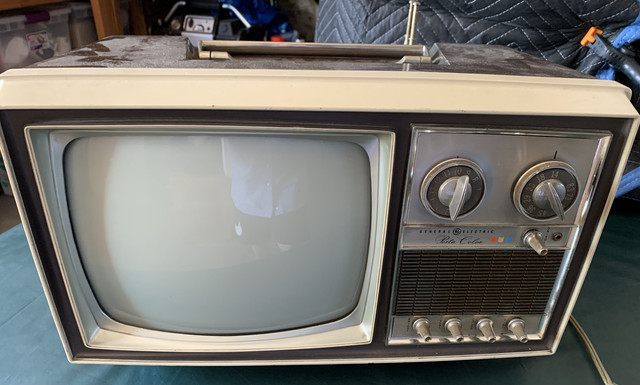
GE produced that set in different variations for about ten years.
Yours looks like one of the earlier models. You have to remove the cover and look for the tube location diagram. The chassis numbers are something like HB, HC, HD and HE with possibly a suffix number.
There's a great deal of difference of the earlier to the later models.
See if you could furnish a picture of the inner view.

Reply With Quote
  #3  
Old 07-15-2021, 07:56 PM
LukeSimon LukeSimon is offline
VideoKarma Member
 
Join Date: May 2021
Posts: 183
Quote:
Originally Posted by dieseljeep View Post
There's a great deal of difference of the earlier to the later models.
See if you could furnish a picture of the inner view.
Thanks! I will take some pictures this weekend and post them here.
Reply With Quote
  #4  
Old 07-16-2021, 03:05 PM
Electronic M's Avatar
Electronic M Electronic M is offline
M is for Memory
 
Join Date: Jan 2011
Location: Pewaukee/Delafield Wi
Posts: 15,453
For as cheap of set these are they tend to be very long lived. I have one that is still all original inside and works fine.

There are things that do fail on them though. The white tubular ceramic cases paper caps which explode and spew metal foil everywhere (One is across the interlock, there's another in the HV cage region, and possibly more), the rear pots are highly prone to developing tin whiskers which will short out the pots and create ALL kinds of strange and tricky to troubleshoot issues, tubes and lytics also can fail.

If it's an HC I may have an old scan of my Sam's somewhere (I think someone uploaded my scan to the ETF site too).
__________________
Tom C.

Zenith: The quality stays in EVEN after the name falls off!
What I want. --> http://www.videokarma.org/showpost.p...62&postcount=4
Reply With Quote
  #5  
Old 07-16-2021, 06:09 PM
zeno's Avatar
zeno zeno is offline
VideoKarma Member
 
Join Date: Mar 2013
Location: New Hampshire
Posts: 4,918
IIRC there were 2 major flavors of GE PC sets. Newer chassii
had a different CRT & high focus. Much better pix. The tube chart
on most GE's will have the chassis ##. Always short & often
letters & numbers. At least they got that right !
LFOD !
Reply With Quote
Audiokarma
  #6  
Old 07-18-2021, 05:44 PM
LukeSimon LukeSimon is offline
VideoKarma Member
 
Join Date: May 2021
Posts: 183
Quote:
Originally Posted by Electronic M View Post
For as cheap of set these are they tend to be very long lived. I have one that is still all original inside and works fine.

There are things that do fail on them though. The white tubular ceramic cases paper caps which explode and spew metal foil everywhere (One is across the interlock, there's another in the HV cage region, and possibly more), the rear pots are highly prone to developing tin whiskers which will short out the pots and create ALL kinds of strange and tricky to troubleshoot issues, tubes and lytics also can fail.

If it's an HC I may have an old scan of my Sam's somewhere (I think someone uploaded my scan to the ETF site too).
The vintage TVs that are still functioning today have gone through decades of testing... decades of testing in the field! The TVs that failed this extreme testing regime have been discarded. Since General Electric made so many of these Porta Colors, they may have been very unreliable on average, but the TVs that survived the decades of field testing are definitely reliable. There is a tradeoff between the wear and tear of this field testing, with the fact that the field testing is great at discovering the TVs that had minor imperfections in the parts and materials that they were built out of. The TVs that were assembled by the crappier engineers in the factory, those also get weeded out by decades of field testing. The vintage TVs we have today were the ones assembled by the hands of the engineers that were the best in the factory, the ones that really cared about assembling the TV as best as possible.
Reply With Quote
  #7  
Old 07-18-2021, 06:13 PM
LukeSimon LukeSimon is offline
VideoKarma Member
 
Join Date: May 2021
Posts: 183
I had some free time this weekend, so I opened up the Porta Color. I find these non-solid state TVs breathtakingly beautiful on the inside when compared to a solid state TV. A solid state TV is like a quartz clock's insides, whereas a tube TV is like a mechanical clock.


Next weekend, I will use compressed air and soft paint brushes to slowly work away the dust, filth, and grime like an archaeologist using brushes to slowly unearth ancient artifacts.


This is the flyback transformer and ultor rectifier diode. Being a budget-grade TV, there is no high voltage regulator, no voltage multiplier either. That would take up space and cost more money.


This is a magnified view of the face of the CRT. It is the more fine grained dot mask type, versus the more coarse grained slot mask type. I will hook this up to my BK 490b CRT Tester to see how it has aged.


The model number was once stamped, in ink, on the back of the TV. I think I can make out the suffix of the model number "HWD-1", but the prefix is not visible. Maybe a blacklight would help?


The tube heater schematic label inside the TV says that it is an "HC" chassis, and the CRT is 11SP22.

Does anybody have the Photofacts for an HC chassis GE Porta Color? For TVs this old, since new capacitors are still being manufactured, I prefer to replace all electrolytic capacitors, paper capacitors, and oil capacitors. I try to keep the original tubes since they are not getting manufactured anymore, so it is wasteful to just throw away the original tubes. However, I do like to order a spare for each tube.

So I need more than just the Photofacts schematic. I also need the parts list, where the Photofacts clearly enumerates the different types of capacitors, and also shows a photo of where to find them in the chassis.
Reply With Quote
  #8  
Old 07-18-2021, 06:55 PM
dieseljeep dieseljeep is offline
VideoKarma Member
 
Join Date: Jul 2010
Posts: 7,562
Quote:
Originally Posted by LukeSimon View Post
I had some free time this weekend, so I opened up the Porta Color. I find these non-solid state TVs breathtakingly beautiful on the inside when compared to a solid state TV. A solid state TV is like a quartz clock's insides, whereas a tube TV is like a mechanical clock.


Next weekend, I will use compressed air and soft paint brushes to slowly work away the dust, filth, and grime like an archaeologist using brushes to slowly unearth ancient artifacts.


This is the flyback transformer and ultor rectifier diode. Being a budget-grade TV, there is no high voltage regulator, no voltage multiplier either. That would take up space and cost more money.


This is a magnified view of the face of the CRT. It is the more fine grained dot mask type, versus the more coarse grained slot mask type. I will hook this up to my BK 490b CRT Tester to see how it has aged.


The model number was once stamped, in ink, on the back of the TV. I think I can make out the suffix of the model number "HWD-1", but the prefix is not visible. Maybe a blacklight would help?


The tube heater schematic label inside the TV says that it is an "HC" chassis, and the CRT is 11SP22.

Does anybody have the Photofacts for an HC chassis GE Porta Color? For TVs this old, since new capacitors are still being manufactured, I prefer to replace all electrolytic capacitors, paper capacitors, and oil capacitors. I try to keep the original tubes since they are not getting manufactured anymore, so it is wasteful to just throw away the original tubes. However, I do like to order a spare for each tube.

So I need more than just the Photofacts schematic. I also need the parts list, where the Photofacts clearly enumerates the different types of capacitors, and also shows a photo of where to find them in the chassis.
That's a really early model, probably the second or third year of production!
I have the last model that used the low focus volts CRT, a 11WP22, which was an improvement over the SP. It uses a few different, later version tubes.
It uses a heftier HO tube. It's an HD chassis, CA 1974 or so.
The HE chassis is the last tube chassis. It uses the HI-focus volts CRT. The code dates are either from 1977 or 78, so it was built that late.
Reply With Quote
  #9  
Old 07-18-2021, 07:04 PM
LukeSimon LukeSimon is offline
VideoKarma Member
 
Join Date: May 2021
Posts: 183
I was able to use a blacklight to make the full model number visible. It is "M244HWD-1".


Then I used newspapers.com to search for that model number and sorted by date. The earliest newspaper articles for it are from September 1967. The advertisements clearly indicate that M224HWD is the model number with the same faceplate as my TV.


I was even able to find a product review article in a newspaper from 1967! Looks like GE made two models, one with a built in clock and sleep timer for the TV, since these small portable TVs were popular as a bedroom TV.


Last edited by LukeSimon; 07-18-2021 at 07:16 PM.
Reply With Quote
  #10  
Old 07-24-2021, 08:23 PM
LukeSimon LukeSimon is offline
VideoKarma Member
 
Join Date: May 2021
Posts: 183
New old stock vintage multi-section electrolytic can capacitors arrived today, as well as new old stock vacuum tubes. Before swapping out these parts, I decided to see how well the TV works with some tuning. The old electrolytics visually look in good condition, the audio does not have hum associated with dry filter capacitors, the picture did not have hum bars or horizontal warping associated with dry filter capacitors, and the capacitors did not get hot at all when the TV was powered on... so surprisingly they seem like they may not need to be replaced. Tomorrow, I will test with an ESR and capacitance meter.


I noticed that some of the vacuum tubes in the TV are RCA. Did GE ever use other brands of vacuum tubes in their TVs, or is this a sign that one of the prior owners has replaced some of the vacuum tubes?

Last edited by LukeSimon; 07-24-2021 at 08:36 PM.
Reply With Quote
Audiokarma
  #11  
Old 07-24-2021, 10:55 PM
Electronic M's Avatar
Electronic M Electronic M is offline
M is for Memory
 
Join Date: Jan 2011
Location: Pewaukee/Delafield Wi
Posts: 15,453
Those are replacement tubes. Dirty little secret tube makers would rebadge their tubes for other TV and Radio OEMs that didn't own tube plants or didn't make a specific type. No maker the size of GE ever sold sets with other brand names on their tubes.
Though often rebadged tubes will have EIA numbers or foreign country of origin (in the case of the Philips of Holland made 6BQ5s in my Zenith Chancellor) stamped on them.
__________________
Tom C.

Zenith: The quality stays in EVEN after the name falls off!
What I want. --> http://www.videokarma.org/showpost.p...62&postcount=4
Reply With Quote
  #12  
Old 07-25-2021, 03:26 PM
LukeSimon LukeSimon is offline
VideoKarma Member
 
Join Date: May 2021
Posts: 183
Quote:
Originally Posted by Electronic M View Post
Those are replacement tubes. Dirty little secret tube makers would rebadge their tubes for other TV and Radio OEMs that didn't own tube plants or didn't make a specific type. No maker the size of GE ever sold sets with other brand names on their tubes.
Though often rebadged tubes will have EIA numbers or foreign country of origin (in the case of the Philips of Holland made 6BQ5s in my Zenith Chancellor) stamped on them.
I am leaning towards keeping the spare NOS tubes in storage, until I get evidence that a tube needs to be replaced. I am amazed that just letting the TV warm up for a while and then tuning a bunch of pots, variable caps, and variable inductors was all it took for such an old TV to work reliably. Mild cathode poisoning in tubes and dielectric breakdown in electrolytic caps that have been without power for decades do need an initial extended period of "warming up". I noticed that with this TV, but now when I turn on the TV after it being off for several hours, it warms up very fast.

Question #1: I was expecting to have to replace many parts. If the white colored foil and paper capacitors are working, do they need to be replaced preemptively to prevent catastrophic failure later on, or if they pass a visual inspection, ESR test, and capacitance, are they safe to keep in place?


Question #2: One of the previous owners of this TV ripped the spade lug off of the dipole antenna's wires. The wire length is about 6 inches, and the shortest replacement wires I can find online are 5 feet long! Any idea where I can find a replacement part?


This grid test pattern shows 2 issues. Vertical linearity near the bottom is a bit squished, I need to spend some time playing with the pot for vertical linearity before asking questions about this. Question #3: The red border of the test pattern is a bit purple at the top and bottom of the picture. The left and right red borders have the proper red color. Is this a color purity issue or a convergence issue?


This color bars test pattern is great for tuning brightness and contrast for each color. Question #4: If you zoom in to the letters for the words "RED" and "GREEN", you can see ghosting to the right of the letters "D" and "N". However, the letter "E" in the word "BLUE" does not have ghosting. The letters and numbers of the columns at the top of the picture also have similar ghosting. What is the potential cause of this? What should I try/investigate to fix this?

Question #5: If you zoom into the red color bar in the area between columns "6" and "7" you can see a dead phosphor triad. Is this repairable? Another dead phosphor triad can be seen in the red color bar in the area between the columns "A" and "B". I have heard of burned up bits of cathode flaking off and shorting the electron gun. Is it possible some burned bits of cathode have flaked off and blocked the cathode ray from hitting a few phosphor triads?

Question #6: The high amounts of "cooked" dust and filth inside the TV, the fact that vacuum tubes have been replaced decades ago, and the cosmetic wear and tear to the outside of the chassis all indicate that this TV has been heavily used. So why does the CRT still output such a strong "bright" picture? Is the CRT model used in these known to have a very long life? I have seen many CRT TVs from the 1990s that have "gone dim" due to heavy usage.

Last edited by LukeSimon; 07-25-2021 at 03:29 PM.
Reply With Quote
  #13  
Old 07-25-2021, 05:48 PM
old_tv_nut's Avatar
old_tv_nut old_tv_nut is offline
See yourself on Color TV!
 
Join Date: Jul 2004
Location: Rancho Sahuarita
Posts: 7,767
"Question #3: The red border of the test pattern is a bit purple at the top and bottom of the picture. The left and right red borders have the proper red color. Is this a color purity issue or a convergence issue?"

This may just be a normal limitation of chroma bandwidth. Those vertical red stripes are far too narrow to be resolved fully by the color-difference signals.
__________________
www.bretl.com
Old TV literature, New York World's Fair, and other miscellany
Reply With Quote
  #14  
Old 07-25-2021, 05:55 PM
old_tv_nut's Avatar
old_tv_nut old_tv_nut is offline
See yourself on Color TV!
 
Join Date: Jul 2004
Location: Rancho Sahuarita
Posts: 7,767
"Question #4: If you zoom in to the letters for the words "RED" and "GREEN", you can see ghosting to the right of the letters "D" and "N". However, the letter "E" in the word "BLUE" does not have ghosting. The letters and numbers of the columns at the top of the picture also have similar ghosting. What is the potential cause of this? What should I try/investigate to fix this?"

May be a bit of delay line ringing, chroma trap ringing, or what have you.
1) I would not obsess over this until having viewed a variety of general material. Test patterns sometimes make visible small issues that aren't a problem in general use.
2) My guess is it's in the luminance channel and is there on blue as well as red and green, but is invisible on blue because of its lower luminance value.
__________________
www.bretl.com
Old TV literature, New York World's Fair, and other miscellany
Reply With Quote
  #15  
Old 07-25-2021, 08:35 PM
LukeSimon LukeSimon is offline
VideoKarma Member
 
Join Date: May 2021
Posts: 183
Quote:
Originally Posted by old_tv_nut View Post
"Question #4: If you zoom in to the letters for the words "RED" and "GREEN", you can see ghosting to the right of the letters "D" and "N". However, the letter "E" in the word "BLUE" does not have ghosting. The letters and numbers of the columns at the top of the picture also have similar ghosting. What is the potential cause of this? What should I try/investigate to fix this?"

May be a bit of delay line ringing, chroma trap ringing, or what have you.
1) I would not obsess over this until having viewed a variety of general material. Test patterns sometimes make visible small issues that aren't a problem in general use.
2) My guess is it's in the luminance channel and is there on blue as well as red and green, but is invisible on blue because of its lower luminance value.
Thanks for the advice, as you can see, I am new to non-solid state TVs. I have been into CRT TVs for years, but only got into non-solid state TVs earlier this year. On my life's bucket list is to collect and restore vintage TVs from each decade, working backwards in time. I am nit picking for issues that I can find. When watching TV, movies, or playing video games on this TV, the issues I am catching in the test patterns are not noticeable.

Question #7: I used a soft, dry paint brush and compressed air to slowly clean away the filth inside the TV, and visual inspection makes me concerned about only one part, capacitor C67, which is one of the boosted B+ capacitors:


I haven't tested this capacitor with an ESR or capacitance meter yet, but it looks like it has leaked a dark waxy substance that does not wipe away with a paint brush. I may be falsely accusing this capacitor. A previous owner may have poured Coca Cola into this TV for all I know. The other non-solid state TV that I have (a black and white Panasonic AN-72), uses an oil type capacitor for the boosted B+ capacitor. So I am guessing that the Portacolor also uses an oil type capacitor. Since the capacitor is sitting right next to the horizontal output tube and the capacitor has to handle a 15khz ripple current, it wouldn't shock me if it has to live with a very high temperature. Does this capacitor look like it has leaked its oil dielectric?
If the ESR and capacitance meets spec, should I be concerned about this capacitor?

Last edited by LukeSimon; 07-25-2021 at 09:02 PM.
Reply With Quote
Audiokarma
Reply


Posting Rules
You may not post new threads
You may not post replies
You may not post attachments
You may not edit your posts

BB code is On
Smilies are On
[IMG] code is On
HTML code is Off

Forum Jump


All times are GMT -5. The time now is 11:58 AM.


Powered by vBulletin® Version 3.8.4
Copyright ©2000 - 2026, Jelsoft Enterprises Ltd.
©Copyright 2012 VideoKarma.org, All rights reserved.