
|
|
|
#31
 10-08-2011, 01:10 PM
|
||||
|
||||
|
I could be nuts, but the Sams manual calls X5 the "AGC amp" and it seems to take input from the 4th video IF as well as from the manual gain control. I am not good at puzzling out solid-state stuff. In any case, it behaves a lot like my RCA 630TS, whose manual gain was called the Picture control. A better label might have been the Twitchy control
 . .Having full gain from the antenna at all times seems good for my setup, where the old TVs primarily receive signals from the in-house modulator. The hum definitely sounds like 60hz. Trying a 12vdc supply should be easy enough. I haven't examined anything in the power supply yet, since it plays plenty bright and plenty loud. A p-s can have noise interference even if it supplies adequate voltage, though. Phil Nelson 
|
|
#32
10-08-2011, 02:55 PM
|
||||
|
||||
|
Hi
I never really paid much attention to that part of the circuit as no problem with it..It's a very poor AGC system for sure...Make sure C19,30uF in the AGC circuit is ok or you might end up with some video modulation on the AGC line. Playing with mine just now on a strong signal the video can be "moved" a lot within the screen by adjusting the normal line hold control at the rear.If it's almost losing lock one one max setting that black curvy part as in your picture appears on the right side.Increasing the manual gain control (on a strongish signal anyway) forces the line oscillator to have a wider pull in/lock in range. Hugh Last edited by Mr Hoover; 10-08-2011 at 03:11 PM.
|
|
#33
10-08-2011, 08:30 PM
|
||||
|
||||
|
It's interesting how the controls interact and how different signals affect it. Here's the same DVD machine playing different program material:
 For this DVD, the gain was turned up higher than for the test pattern DVD. No gap on the right, and there's probably still some warping, but not much you would notice. Now that it basically works, I can spend some time finding the best compromise with the various adjustments. I'm still curious about that vertical bias control, too. I was hoping to avoid it, but I need to remove the CRT to recoat the bell with Aerodag graphite and clean the inside of the safety glass. The CRT is shedding flakes of aquadag and some of them end up inside the cover. If you look back at the earlier photo of Hilary Swank, you'll see a big black flake that's not present in later photos. I tried blowing them out with a little rubber hose, and just created a mini blizzard of black flakes, so the old coating is not done shedding. Phil Nelson
|
|
#36
10-08-2011, 11:05 PM
|
||||
|
||||
|
An interesting comparison. The 8-PT and 8-301W are both compact portables with stacked chassis (er, boards) surrounding the CRT neck. The clever lads at RCA even made it possible to slide the PT subchassis back on their rails, leaving things connected, so you can power up the TV in its "exploded" state.
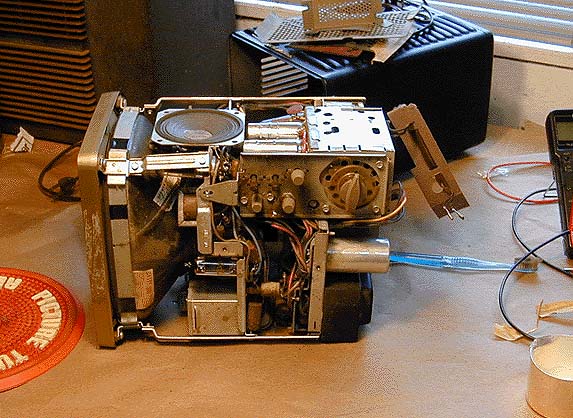 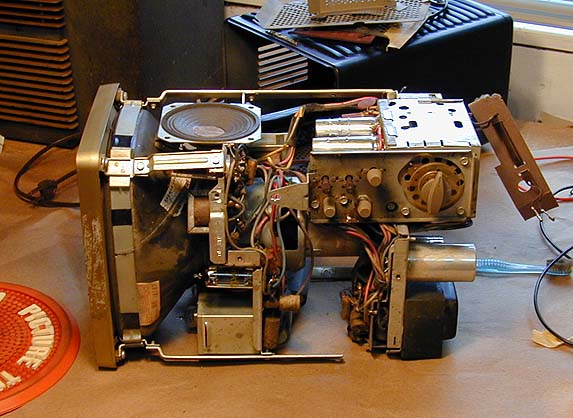 After I finish off this guy, maybe I will sit down with both schematics to compare & contrast. The 8-PT sets are pretty nice performers, all things considered. Phil Nelson
|
|
#37
10-09-2011, 01:00 AM
|
||||
|
||||
|
Is this yoke ringing?
  Obvious when brightness is turned way up (first photo). The bands are stronger on the left and fade toward the right. Not so obvious when brightness is more normal (second photo), but you can see slight waves in the horizontal line that match the vertical bands seen in the first photo. One of my TV books says that yoke ringing (if that's what this is) can be cured by replacing an open yoke balancing capacitor, but this TV appears to have no such capacitor. If there's no simple cure, then so be it. I'm more curious than concerned, not having seen this in other TVs. Phil Nelson
|
|
#38
10-09-2011, 01:34 AM
|
||||
|
||||
|
Ah yes,they all "ring" to a greater or lesser extent.
Check the rectified supply from the horizontal output transformer feeding the video output transistor hasn't any ripple on it C39 10uF would be the chief suspect. . Removing the tube isn't so bad,getting it back in is harder I think,had to do the aquadag on one of the CRT's also. This was really one of the first transistor TV's,Sony had no history of making them before and learnt from the experience on their next models.The thought with servicing seemed to be as a TV shop if you had a fault on a panel send just the bad one back to them for replacement. There was a portable transistor TV made by Perdio in the UK in 1962 that looks very similar in a way with the front push buttons,it used the same CRT as the Sony though had a plastic case. http://www.thevalvepage.com/tv/perdi.../portorama.htm Access to this was much easier,all the panels just swung outwards on a frame much like the RCA one.The TV was a bit "strange" in performance,though it did have good AGC. ~ Hugh Last edited by Mr Hoover; 10-09-2011 at 03:23 AM.
|
|
#39
05-29-2012, 03:56 PM
|
||||
|
||||
|
GREAT read Phil!!
This and the thread over on antiqueradio will give me enough confidence to dive into the 8-301W I just couldn't leave behind at the swap meet Sunday. I did go ahead and download the SAMS for this unit on their site. Was only 15 bucks....so likely the easiest way to learn the most about this little set. You may recall from the other forum that I joined BOTH these forums because THIS set is likely to change me from merely a collector to actual restoration. The cosmetics and the fact that the set is 100% complete made me buy it in the first place. The worst that could happen from giving the guy $30 he wanted, would be to end up with ALOT of really great sheetmetal and knobs to pretty up another one, so it was a no-brainer really. This was actually the VERY first time I had seen one in person. I walked by the thing like four times in the span of a couple hours. I had ONLY seen a couple on ebay...ALL with issues or REALLY rough looking described outright. I wasn't gonna SLEEP well Sunday night if I didn't at least have a go at this :-P Mine DOES come up, but does have some classic electrolytic symptoms such as "takes like 10 minutes to stay synced", and has linearity issues for just about that same ten minutes. At first I kept "cleaning it up" with the controls and tweaks....only to turn it on a couple hours later and see it "back in trouble again". I learned Monday to just LEAVE it run and having issues, and then around 10 minutes later it eventually looks "just okay". There is some weird horizontal issues that stay though. real bad tearing if you see something like white text on a black background...and still a persistant little static sound in the audio that will come and go. Sounds JUST like a bad volume pot, but touching the pot (after cleaning them all up) doesn't change it. It'll make this static thing for like 15 seconds or so...and then be FINE for like ten minutes, and then do it again. I'd REALLY like to have this set all pretty. It's BY FAR the neatest looking little set I've run across...and is even older (1961?) than the Sony 5-303 my Dad gave me (around 1965?). It's only cosmetic issue is it looks like someone at some point had whacked the sun shield against something. I had VERY carefully wrapped just the sunshield in a dishtowel and slowly pounded it flat again with a rubber mallet. It still shows a little crease though where it was bent, but I can work on that later..... not anywhere near as dramatic, and it now "fits" correctly on the little rails on either side as well. This crease (and pounding it back carefully) didn't even crack the VERY hard to duplicate original "crackly stuff" that case and shield are painted with. Last edited by AiboPet; 05-29-2012 at 04:02 PM.
|
 |
|
|


 Linear Mode

