
|
|
|
#16
 11-10-2006, 12:43 AM
|
||||
|
||||
|
Well... I dont know much about Admiral, but.... These old Color sets are for the most part pretty generic...
Do you have high voltage now? There is a jumper on your schematic to check the H.O. current, (which will of course be too high if the plate is too hot, but I would see how much it is). I would check that. These Horiz. sections are tuned much like transmitters. If they're out of tune, the HO tube draws too much current. There should be a "horizontal effeciency coil" somewhere. On the other hand, this was a sudden failure? Got a bit of the schematic showing the HO, damper, HV rect., 6bk4, etc? John 
|
|
#17
11-10-2006, 12:56 AM
|
||||
|
||||
|
John -
No high voltage whatsoever at the moment. This was indeed a sudden failure - the damper tube arced a couple of times, but the set was still working when I turned it off 15-20 seconds later. I didn't power it up again until after I replaced the damper tube (about a week or so), and it was dead at that point. Re: tuning the frequency: I'm going to bring my function generator home from work tomorrow to set up my scope; that way I can make sure that the oscillator is indeed on frequency. There is a horizontal efficiency coil in the plate circuit of the damper tube. I'll scan in the high-voltage section of the schematic tomorrow and post it. Thanks! Jim
|
|
#18
11-10-2006, 01:09 AM
|
||||
|
||||
|
The oscillator should set the frequency, since it is locked by the horiz AFC. The HO tunes like a PA tube, using the efficiency coil, in most if not all cases. Minimum current, or minimum current and 1/4 turn to eliminate foldover or something like that.
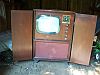
Thats a really cool looking set. I used to have a Zenith in a similar looking cabinet. It wasnt as pretty as your Admiral, though. 
|
|
#19
11-10-2006, 03:42 PM
|
||||
|
||||
|
Your new damper tube could easily be the problem. Been there done that.
|
|
#20
11-11-2006, 11:05 AM
|
||||
|
||||
|
Schematic
Here is a scan of the schematic from the HV section. There is one change - the previous owner replaced the flyback some 20-odd years ago and the instructions for the new flyback state that pins 4 and 10 of the 6KD6 are to be grounded.
Holmesuser01 - thanks for the suggestion about the damper tube. Is there a way to test that theory or is it just a replace-it-and-see type of thing? There's a guy fairly local to me who sells tubes; that's where I got the replacement horizontal tube. I'll have to give him a try. If nothing else, I'll have enough spares to last me for quite a while To all - Thanks again for all your help on this set and with cataract removal. I'm still getting my feet wet, and at times these problems can be quite daunting. Hopefully someday I will be able to be one of the ones providing the help! Jim
|
| Audiokarma |
|
#21
11-12-2006, 11:20 PM
|
||||
|
||||
|
Hmmm....
Your idea of checking the exact frequency of the Horiz. oscillator is probably a good one. It would also be a good idea to check again the DC voltage, and the AC waveform on the grid of the HO tube. Were you checking it at the tube socket? Could r729 be open? How about c448? The equivalent capacitor in one of my sets had gone up(!) in capacitance, and it threw the horiz. frequency off. It didn't throw it off far enough to cause this kind of trouble (the AFC pulled it back in), but it was off nonetheless. I have heard of the capacitance of this cap going down in RCA sets, causing insufficient drive, and constant HO tube failures, due to excessive current. Ok, if we have good drive and the correct amount of DC on the grid of the HO, and the HO is still getting hot, probably I think HV system is overloaded. The HO screen voltage would be a good clue here. Is it too high or too low? Do I understand that the HO is getting hot and the damper is not? I also like the idea of trying another damper. If the CRT guns are biased full on, it would probably pull enough current to kill the HV. You might try it with the CRT socket disconnected, and see if the HV comes back. If it isn't that, I guess we'll have to go looking in the focus rect. or HV regulator circuits.  Regarding the grounding of the suppressor grid, some sets (other brands) came this way and others had the option of connecting it either to a voltage divider that supplies about 80v (like the one on your schematic), or ground. You would change it if you had a parasitic oscillation (snivet) in the HO tube. You knew you had one, because it would modulate something, causing a dark vertical line or area on the screen. If you don't have a snivet, I would leave it the way the flyback manufacturer wanted it. Good luck, John
|
|
#22
11-13-2006, 06:12 PM
|
||||
|
||||
|
John -
Yes, I wanted to verify that the oscillator was on frequency after recapping and changing resistors in that section. Plus I wanted to make sure that the horizontal hold control hadn't been disturbed (the chassis has only been in and out about eight or ten times so far.. )The waveform I am seeing is at the grid pin of the HO tube socket. I've checked R729 and it is within spec. I have the HO tube out for testing, but am going to put it in and see what I get at that pin as well. I also plan on measuring the screen voltage then as well - with the tube out the screen voltage is simply B+ - and a bit high at that. I haven't looked at C448 as it is a ceramic according to the parts list, but could measure it and change it if necessary. As far as I know, the damper isn't getting hot. I haven't looked at it closely though; I focused on the HO tube since that was the first one I saw with a glowing plate. Will keep everyone updated.... Jim Will remove the socket from the CRT and see what happens when I get home tonight.
|
|
#23
11-13-2006, 10:45 PM
|
||||
|
||||
|
John -
Just finished messing with the set for this evening. Here's what I've found out: 1. The oscillator is on frequency (at least as close as I can get with my scope). 2. Screen voltage starts out at about 450 at power-on, and drops to a low of about 75 and then begins to rise again. Haven't made it past this point since the HO tube starts to glow. The two schematics I have for this set show 90VDC and 180 VDC for the screen voltage. 3. Removing the picture tube socket had no effect on the high voltage (or lack thereof). Same with removing the focus rectifier. 4. The cathode of the damper tube is also glowing. I hadn't noticed until you mentioned to look for it. I'm going to pull it out in a second and check for shorts between the elements. Jim
|
|
#25
11-14-2006, 08:36 PM
|
||||
|
||||
|
Here is a silly idea but how about unplugging the convergence board...just to make sure something in that circuit isn't causing a problem.
Also I would take the yoke off the CRT and check carefully for burns on the underside. Have some RCA sets where somehow the yokes shorted out and burned the enamel off the wiring.
|
| Audiokarma |
|
#26
11-18-2006, 07:21 PM
|
||||
|
||||
|
Well, unplugged the convergence board, and still no go. Also removed all of the tubes from the high voltage section and looked for inter-element shorts. Didn't find anything of note.
Can the set be operated without any of these tubes in place (HV rectifier, etc?)? I would assume probably not the HV regulator though. Have an order in for a new damper tube but it won't ship until after Thanksgiving. Going to pull the yoke off hopefully this weekend and look for burnt spots and see if there is anything I can tell through further examination. Any way to see if the flyback is the problem? This one seems to be a lot tougher than the one in my other Admiral - it's encased in silicone rubber rather than wax. Thanks again to everyone for all the help. I'm learning slowly but surely - and I will get this set going eventually. Jim
|
|
#27
11-18-2006, 07:34 PM
|
|||
|
|||
|
Quote:
There is a test you can do if you have a scope and a square wave generator. You have to disconnect all the wires from it and apply a square wave to one of the windings through a resistor. Monitor this signal on the winding with a scope. A good flyback will ring with each pulse that hits it. Any shorted turns will cause the oscillations to stop very qucikly. A google search should find a detailed description of this test.
|
|
#28
11-18-2006, 10:22 PM
|
||||
|
||||
|
Also you might check the 6bk4 current. There is a 1k resistor in the cathode circuit. Make sure it's still close to 1k, then hook a meter across it and read the current as voltage. Sometimes if a 6bk4 arcs or otherwise fails, it will toast some of the resistors in the grid circuit. Also the grid capacitor can short. I see from the schematic that the grid capacitor has a spark gap across it, probably to prevent damage, but I would be a bit suspicious of it nonetheless. If the bias on that tube was all screwed up, it might be drawing all the current the system can produce.
John
|
|
#29
11-18-2006, 10:29 PM
|
||||
|
||||
|
I have had the 6BK4 problem too. Burned resistors in the grid/cathode circuit and the 6BK4 was drawing about 2000 microamps (2 milliamps) and overloading the flyback causing it to overheat and no HV going to the CRT.
The recommended current is about 800-1000 microamps (.8 to 1 volt on the meter across the 1000 ohm resistor) Both sides of the resistor are "Hot" B+ voltage. Get a neon test lamp and tape it to a non-conductive stick and hold it carefully against the horiz output plate lead insulation (no direct connection) and this will tell you if there is AC high voltge being developed at the flyback primary if it lights. Last edited by Chad Hauris; 11-18-2006 at 10:33 PM.
|
|
#30
12-07-2006, 10:10 PM
|
||||
|
||||
|
Damper tube.......... :(
Well, it was the damper tube after all. Been busy here with work and all and finally got another damper tube. Put it in and the set came right up - horizontal on frequency and all!
 Probably should have subbed it out when all of this started, but figured it couldn't be something as simple as a tube, now could it.. Well, it's now got a new horizontal output tube and a rebuilt horizontal section, so I shouldn't have to worry about that for a while Have to get a spot cleared in my basement so I can get this monster down there and work on it instead of in the garage (It's cold in Joliet this time of year!). Going to go fire it up again, check the horizontal current, and do a quick setup of focus, screen, etc A very heartfelt thanks to everyone who offered assistance. I'm sure this stuff seems like a cakewalk to you guys most of the time, but to a newbie staring at a set that just <bzzzzzt> crapped out, it can be quite daunting. Your information was very helpful and hopefully stimulated the thought process for the next time I've got a set to work on. I only hope that one of these days I can 'pull my weight' on these forums. Jim
|
| Audiokarma |
 |
|
|



 Linear Mode

