
|
|
|
#17
 02-10-2011, 09:05 AM
|
|||
|
|||
|
Quote:

|
|
#18
02-10-2011, 12:27 PM
|
||||
|
||||
|
Quote:
Your set is looking great! good luck with the re-cap job! jr Last edited by jr_tech; 02-10-2011 at 05:11 PM. Reason: typo
|
|
#19
02-10-2011, 01:11 PM
|
||||
|
||||
|
3 of 'em have managed to find me-Plus one of the Emerson AM radio/TV combos, which uses the same CRT. Oddly, the best cosmetic-condition one-a sort of grey-beige version-has a CRT that's about shot.
__________________
Benevolent Despot
|
|
#20
02-10-2011, 08:09 PM
|
||||
|
||||
|
Sandy, Is that emerson am/tv you have got UHF? Ive got one here with no knobs and i need to see pics if its the same ..
Steve
|
| Audiokarma |
|
#22
02-10-2011, 10:38 PM
|
||||
|
||||
|
Thanks for all the comments! I've been trying to be extremely careful with the set.. was annoying to crack the little knob, but such is life. The plastic antenna mount is broken on mine, I'm going to try to repair it with epoxy or JB-Weld before I start to search for a replacement. The quality of construction is amazing... even after looking at all the photos on Phil's website, I can't say I was prepared for how small it actually is! The only other place I've seen the same size and type of potentiometer, is in old 50s Motorola two way radios... the type with submini tubes. Makes me wonder what modern electronics would look like had the Japanese never become involved in things.
|
|
#23
02-24-2011, 09:27 PM
|
||||
|
||||
|
About 75% done replacing capacitors - wow there's a lot, and wow is it small! Work is going well though! There is an error in the parts list, in the RCA manual. C164 is listed as 0.001uf, but in the TV and on the schematic it is really 0.022. I paralleled two 0.01's, couldn't find any 0.022's locally.
|
|
#24
02-25-2011, 12:13 AM
|
||||
|
||||
|
All done except electrolytic can. Gonna restuff it this week, but it isn't warm in operation. TV picture looks awesome, it's sharp, with great geometry. Not perfect, but very close!
Sound has a lot of buzz when text is on the screen, but otherwise is good. I suspect there's not much I can do about this? It's nice to see this little guy alive!
|
|
#25
02-25-2011, 05:00 PM
|
||||
|
||||
|
Have a couple more observations about this little TV.
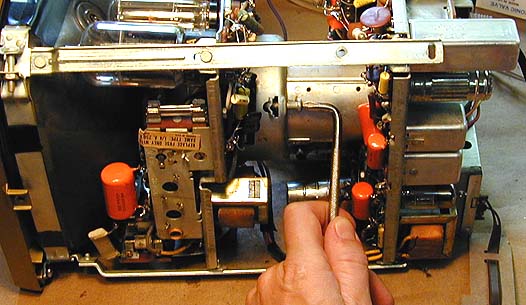
1) The problem Phil encountered with the picture being tilted, seems to be because the yoke is held in place with spring pressure, and rotates on its own a bit when the chassis is installed back into the cabinet. It can be corrected by removing the control door, and inserting an insulated flat blade screwdriver into the tv with the guidance of a flashlight, and using it to move the yoke into correct alignment. It seems like every time I move the TV, the picture gets a bit tilted. 2) The TV is fairly poorly shielded. My cable box puts out a signal on 3, and since there is also a broadcast station on this channel, the interference ends up as lines on the picture. Using a VCR as a video modulator gives me a nice crisp picture. 3) White screen or text puts an unacceptable amount of buzz into the audio. Can anything be done to help this?
|
| Audiokarma |
|
#26
02-25-2011, 05:51 PM
|
||||
|
||||
|
I may be remembering wrong, but I think that there is a large Phillips head screw on the outside of the yoke housing near the bottom that pushes a collar with fingers against the back of the yoke to hold it in position.
jr
|
|
#27
02-25-2011, 06:28 PM
|
||||
|
||||
|
Quote:
When I rebuilt one I discovered the long metal shield around the neck of the CRT had to be in place or it wouldn't get a raster, possibly the Ion trap was weak or just so tiny it wouldn't work without the shielding. Originally these had a long stiff piece of fish paper attached to the Ion trap and extending out the back far enough to adjust the trap by removing the rear cover, this is often to brittle to use after 50 years and either has to be replaced or you have to adjust the trap with a non ferrous stick of some sort. BTW Max, I still need to look for the rear cover for you, if you can't fix the antennas you'll need it to cover the hole. Remind me if I don't contact you soon, I forget things easily these days.
|
|
#28
02-25-2011, 06:37 PM
|
||||
|
||||
|
I've had the TV on all afternoon... it seems the buzzing has quieted down to such a low level I almost don't notice it since the TV has been really fully warmed up for hours. Figured out my CRT computer monitor is interefering with the picture on the RCA. Easy to solve that, I don't plan on keeping the RCA in my computer room anyway! So far I've been operating it with the antennas down, but Eric if you do dig up a rear cover I'd like to get ahold of it. No big rush, it's working fine as is.
The fish paper is intact on my TV, but haven't had a need to adjust the ion trap yet - picture is good and bright as is. I'm getting used to life in black and white!
|
|
#29
02-25-2011, 07:03 PM
|
||||
|
||||
|
I have had many 50s sets that buzz when white lettering is displayed on the screen, and others that don't. It seems that I have read a technical explanation as to why this occurs, but I don't think that it indicates any problem in the set itself. I wonder if slightly adjusting the AGC control might help? It would be worth a try and certainly can't hurt anything. The portable might not even have an AGC adjustment. The main thing is noting approximately where the original setting was for what I call backward reference. LOL!
|
|
#30
02-25-2011, 09:06 PM
|
||||
|
||||
|
Quote:
 Many old TVs buzz in scenes with very high contrast. Aligning the sound section can help, but on some sets you may never eliminate it entirely. Backing off the contrast will reduce it. Sound buzz is more noticeable now than in Ye Olde Dayes because contemporary TV programs are littered with constant text crawls along the bottom, animated logos, etc., etc. Phil Nelson
|
| Audiokarma |
 |
|
|


 Linear Mode

