
|
|
|
|
|
#1
 06-19-2010, 04:21 PM |
||||
|
||||
|
Quote:
 Laserdiscs can get noisy when the aluminum reflective layer starts to break down. Some much worse than others that still play remarkably well. But even new discs would have a speck here and there, or an occasional crawling dot as a minor defect passed by. I think my friend has a CX box if you ever decide you need one. Those pro machines were probably designed to ignore the macrovision garbage, and some may have manually adjustable video rec level controls so that also makes the copyguard signal ineffective since that messes with the recorder's video record automatic gain control to disrupt the picture. You have a nice project getting all that to interface and work together. Without looking as I no longer have access to any of the JVC service manuals at the old shop, if the heads seem OK might be a failed electrolytic on the head amp board, or on the cylinder stator board if it has a similar setup I am thinking about as many JVCs had in the late 80s-early 90s which caused the phase of the head-switching signal to be all out of whack from where it's supposed to be. I've also seen heads that were clogged with something that would not clean off no matter what, and I would have to use a head lapping tape to polish off the crud. What happens if you record on that one with no playback and play that tape on a good machine? Last edited by Ed in Tx; 06-19-2010 at 04:26 PM. 
|
|
#2
06-19-2010, 07:22 PM
|
|||
|
|||
|
Hi Ed,
These machines do have adjustable video record level as an option, along with seemingly hundreds of menu-driven adjustments I dare not mess with for lack of knowledge of what they do! I hadn't considered recording on the bad one and seeing how it plays on another machine, thanks very much for the tip. I'll also study the service manual for more clues - too bad I can't twirl my hand fast and accurately enough to inject a head signal into that large SMT chip on the spinning board. I have one of those cheap handheld video head testers, but of course they won't identify a clogged head. Well, maybe I can look for a dramatic change in inductance between the heads just for fun. I also haven't tried a dry type cleaning tape, and I might just have one around. A machine of that age could definitely have bad electrolytics pretty much anywhere; in fact I stole the audio output board from the bad machine over this. I stock hundreds (or thousands) of all standard values up to 1000 uF, but generally don't keep many NP's around which were the culprits in this case. I could get really intense and try measuring in-circuit capacitance of the SMT caps, but I'm more likely to just replace them once I determine the values. I'll try to shoot you a protrusion measurement in microns on these heads if I can find time over the weekend, but a quick and gentle finger-rub feels like well over 20 microns on all of them. I had pretty much written the machine off as a parts unit, but here's my chance to really make sure it's the heads, and learn a lot besides. Considering the way these machines performed after routine mechanism removal, cleaning and lube, looks like the previous owner(s) kept up the maintenance and alignments very diligently. Almost a disappointment for a curious technician, but at least I have some Beta machines to mechanically align and keep any hair from accumulating on my head! Thanks again for the tips, I'll keep you posted. Cheers! P.S. - If I keep getting older, I may need to project scope waves on my wall too! My wife is an old California hippie, so the process is sort of pre-approved if I play some Iron Butterfly while I troubleshoot. Last edited by Barry777; 06-19-2010 at 07:27 PM.
|
|
#3
06-20-2010, 12:47 PM
|
||||
|
||||
|
Quote:
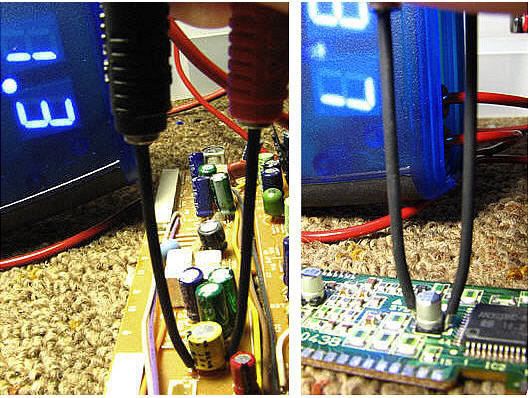 (Hi-fi audio board out of a 20 year old JVC HR-S5800.) Last edited by Ed in Tx; 06-20-2010 at 07:30 PM.
|
|
#4
06-27-2010, 10:19 AM
|
|||
|
|||
|
Hi Ed,
An ESR meter is one of very pew pieces of gear I haven't acquired yet, and thanks for the tip. I'll try to get one as soon as budget permits. Looking at the service manual for my BR-S822U, there are 4 SMD electrolytics (.47 uF) that appear to deal with the headswitching on the flying PRE/REC board. I'm tempted to temporarily swap standard electros (all I have in stock) just to see what happens. These 4 electros appear to be in identical circuits, looks like they all supply DC control voltages to op amps inside the UPC2320GS chip on the flying board - but this is strictly a half-educated guess. There's also a control signal that comes from the slip ring, but I admit that I've traditionally been a "belt and tire" guy and haven't studied the deeper areas of VCR electronics to know what this control signal should be or where it comes from. I should have all the equipment I need to troubleshoot - just need a bit more knowledge which I will study as time permits. But since the 4 electros in question are in identical circuits, maybe I can do a quick-and-dirty comparison of capacitance before pulling anything up. Here's a schematic of the flying preamp board: www.barrys8trackrepair.com/PreBoard.html Sorry it's not the clearest. Have a great Sunday!
|
|
#5
06-27-2010, 11:16 AM
|
||||
|
||||
|
Quote:
I see now what you are dealing with. This is where I need the rest of the manual to follow the schematic. The pinout of the cylinder assy to the boards it connects to might help. Not the motor but the signal part. I would look at the +5V, the PB head-switching signal, the amp mode signal, the slip ring condition, and if there's any PB FM signal coming out while it trys to play a tape.
|
| Audiokarma |
|
#6
06-27-2010, 12:49 PM
|
|||
|
|||
|
Hi Ed,
Thanks to your tips, it looks like I've found the video heads to be okay. I recorded color bars on the bad machine, and I do get a constant video signal when played back on a good machine. The color flickered in and out, so I tried a monochrome crosshatch pattern. It played back with constant video again, and was very jittery both up-and-down and left-to-right, but at least it appears that the heads are recording, so they should be capable of playback also? The head switching point was near the top of the screen which doesn't seem right. I checked the menu settings on the bad machine (and also reset everything per the manual) which didn't seem to fix anything. I took care to make sure the switching point is properly adjusted at 6.5H for recording and 4.5H for playback in the menu adjustments - but I know the software controls can only do so much if the circuit itself is faulty. So now it's starting to look like an electrical alignment issue. I don't know if anything on the flying REC/PRE board would continue to be suspect now, but I did check those 4 electros with a cheap cap meter - all read around .56 uF though I'm sure the ESR could still be bad. My control signal (30 Hz?) is making it to the slip ring, and the ring and brushes appear okay visually. I do have about +2 volts of DC offset in the control signal, not sure if that would throw off any bias stuff in that preamp chip - and it might be normal anyway. I think it's time I spent several evenings learning some basic VCR theory, studied the manual intently, then set up the bench for a full check of the alignment. I haven't checked the servos yet with the VC93, but the head switching point pretty much stays in the same place and the video playback is consistant on the good machine, albeit jittery. My limited knowledge at this point suggests a problem somewhere in the head switching circuitry and probably more (sheepish grin). Sounds like an ESR meter is great for in-circuit cap checking? Which one would you recommend? I'll quit for today and let my brain soak up what I've learned so far, then maybe hit it again next weekend. This VCR is more a fun project rather than anything urgent - my chance to learn something about electronics which I somehow manage to do for a living :-)
|
|
#7
06-27-2010, 01:44 PM
|
||||
|
||||
|
Quote:
About a year ago I bought my 2nd ESR meter in kit form: http://www.anatekcorp.com/blueesr.htm If you shop around for this one, you can find a deal that might still include the optional stand for it, free. I also still have my original Dick Smith Electronics from Australia ESR meter, from about 10 years ago. It was also a kit, but it's been discontinued for a few years. http://www.electronicrepairguide.com...or-tester.html I'm not sure what's available these days, but I think there are some lower cost already assembled ESR meters. Others I see are now combining ESR and capacitance test in one meter.
|
|
#8
06-27-2010, 01:46 PM
|
|||
|
|||
|
Well, this is interesting. My control signal is reading 15 Hz during playback of any tape, even a brand new blank tape. It reads the usual 30 Hz until it loads a tape, then reads 15 Hz thereafter. When I eject the tape, it goes back to 30 Hz. So there's a good starting point - surely a 15 Hz control signal can have something to do with this. I'll see what happens when I force it to 30 Hz with the VC93.
|
 |
| Thread Tools | |
| Display Modes | |
|
|


 Hybrid Mode

