
|
|
|
#1
 06-05-2009, 06:06 AM
|
||||
|
||||
|
Uniquely American
 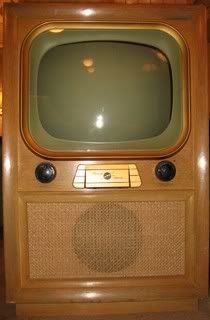 The model number is known actually, it's American Television 2001A. I've had this set for about four years. In the time since I acquired it I have learned that American Television was headed up by mechanical TV pioneer U. A. Sanabria, whose Western Television had manufactured the Visionette, Empire State and other 45-line triple-interlace TV models back in the mechanical days. In the 50s, his sets were variously branded American, DeForest and DeForest-Sanabria. It came to me with the base whacked off of the CRT (the cathode lead came off with it, snapped flush with the glass), a condition which kept it in the back of the to-be-restored queue until I recently acquired an 8" test CRT. I did not, however, acquire a schematic. Instead I traced out my own. In doing so I discovered just how unusual this set really is. There are four distinct B+ lines, only one of which comes off the conventional source. It measures about 365 volts. There also is a 425 volt boost line--nothing unusual about that as it serves the vertical sweep section, except it also provides focus voltage for the CRT. Another source is the rather unconventional 150 volt line, a circuit which leaves a guy such as myself scratching his head wondering what's missing, as this line has no apparent source. But the fourth B+ line is really something else. Trace it back far enough and it does connect to the main B+ which accounts for it measuring within a couple volts of 365. But this fourth line, which provides plate voltages for several tubes including audio and video output, first passes through the flyback and yoke.  So the process was: trace the circuit, rub my eyes in disbelief, confirm that what I drew is in fact how it's wired, move to next circuit, repeat. With its sparse count of 17 tubes on top of the chassis, I was always skeptical of how well it would work. Once I got a got a look underneath the chassis I was skeptical IF it would work. I'm very pleased to report that, for all the set's eccentricity and economy of parts, Sanabria was no Muntz. 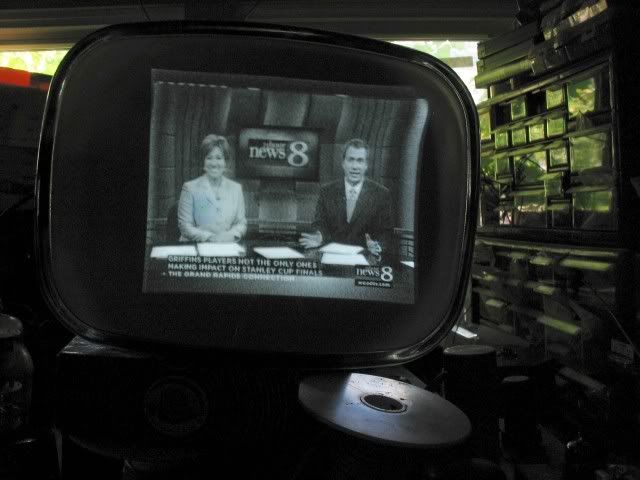 That's an off-air capture using rabbit ears (for close to the last time)  The set shows absolutely no retrace whatsoever. Even when running on an RF modulator it is not the least bothered by white/hi contrast scenes and has as minimal sync buzz as any set I've restored. The next step is to determine whether the CRT is salveagable and, if not, where I might find a good one. 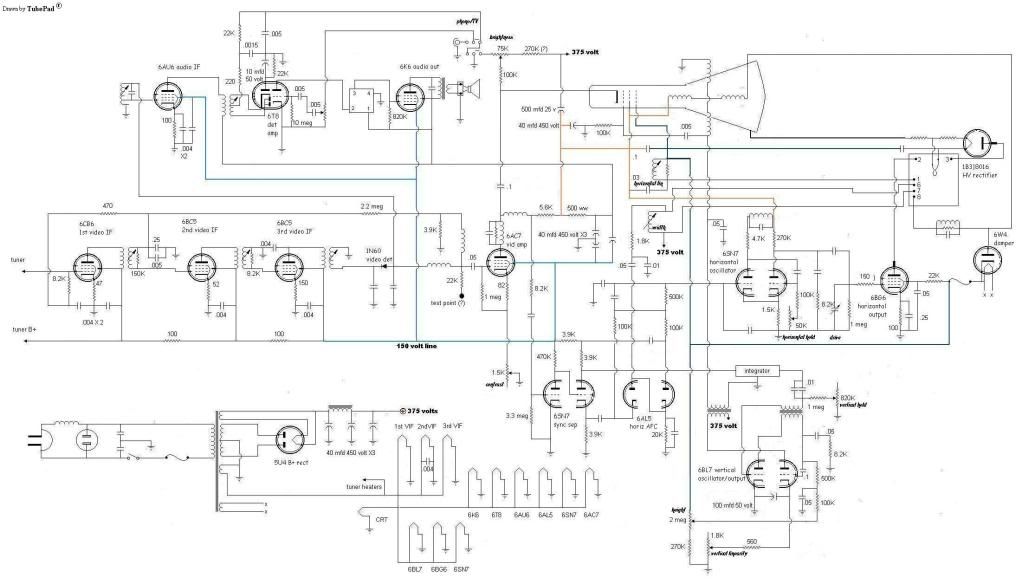

|
|
|


 Threaded Mode