
|
|
|
#1
 12-17-2010, 11:51 PM
|
||||
|
||||
|
My First Vintage Television
Today my girlfriend gave me this television for Christmas.
 I had seen it at an antique mall a couple months ago but restrained myself from buying it. I love it, however, it has the major problem of not showing a picture. All that happens when I turn it on is that I hear the high pitched "squeal" that you hear from a tube tv and some static coming from the speaker. I know that there aren't any analog channels to transmit a signal, but I was expecting at least some light to come from the display. The other problem is that I can't seem to find a model number anywhere. All that I know is that it was made by Westinghouse..I'm guessing mid-late 50s? This has been an issue in finding specifications such as age and troubleshooting tips. Anyone have any info? I had seen it at an antique mall a couple months ago but restrained myself from buying it. I love it, however, it has the major problem of not showing a picture. All that happens when I turn it on is that I hear the high pitched "squeal" that you hear from a tube tv and some static coming from the speaker. I know that there aren't any analog channels to transmit a signal, but I was expecting at least some light to come from the display. The other problem is that I can't seem to find a model number anywhere. All that I know is that it was made by Westinghouse..I'm guessing mid-late 50s? This has been an issue in finding specifications such as age and troubleshooting tips. Anyone have any info?Thanks! Sid 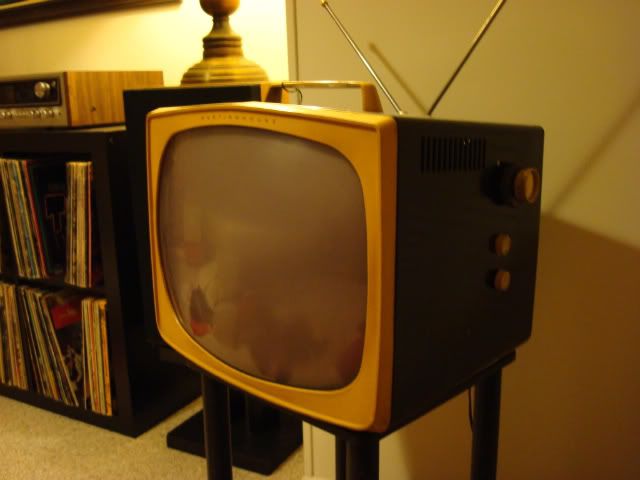
__________________
If you don't know, come to learn If you know, come to teach. 
|
|
#2
12-18-2010, 12:13 AM
|
||||
|
||||
|
Awesome present - I never get stuff like that!
Please don't turn it on again before doing some troubleshooting. You're likely to burn something out. That high pitched squeal is probably from the horizontal / high voltage circuit around 15 kHz. Most likely some capacitors have gone bad and are causing problems. I'm not sure of the model, but I'm sure someone else does. P.S. Sweet PF profile pic 
|
|
#4
12-18-2010, 03:02 AM
|
||||
|
||||
|
Quote:
__________________
Growing up leads to growing old and then to dying, And dying to me dont sound like all that much fun... -John Mellencamp
|
|
#5
12-18-2010, 08:50 AM
|
||||
|
||||
|
Things could be coming up but the CRT may be a little too dim to tell what's going on. Did you try this set in a dark room or turn off the lights?
Reguardless, you have some initial troubleshooting to do so try to resist the temptation of any more power ups before checking it out. As for information, find the model and/or the chassis numbers and with an index book we can find what the Howard Sams Photofact schematic is for it. Your girlfriend must not understand the addictive effects that come with TV collecting.... 
|
| Audiokarma |
|
#8
12-18-2010, 12:49 PM
|
||||
|
||||
|
You will need to replace the old electrolytic and paper (or plastic-coated paper) capacitors if you expect it to play reliably:
http://antiqueradio.org/recap.htm The capacitors go bad with age, so this is necessary even if the TV was never used. The TV might have additional problems that were the reason it was retired. If you finish recapping and it still doesn't work, people in this forum can help you diagnose what other repairs it might need. If you browse the TV articles in this section, you'll get an idea what's usually required to make a vintage TV work normally. http://antiqueradio.org/restoration.htm If you never restored a tube device (radio, TV) before, a television is not a good beginner's project. It has high voltage, which can be dangerous, and if you make a mistake while replacing dozens of parts, the TV will not work, anyway. This article has advice on finding a repairman: http://antiqueradio.org/howfix.htm I would not turn turn it on any more until you have at least replaced the electrolytics in the power supply. You wan't learn anything more (it doesn't work, duh) and you might damage it. Phil Nelson http://antiqueradio.org/index.html P.S. Cool looking set.
|
|
#9
12-18-2010, 01:17 PM
|
||||
|
||||
|
Over the summer I worked on re-capping a Zenith console radio so I have a some experience with this. Phil, your recapping article helped me out a lot with this project. What kind of safety precautions should I take when recapping this tv? Is it unsafe even when unplugged? I hope this isn't too out of my league.
__________________
If you don't know, come to learn If you know, come to teach.
|
|
#10
12-18-2010, 01:41 PM
|
||||
|
||||
|
Lucky dog! A nice set and a thoughtful girl friend.
I'm guessing that it's later than 1957. There's a portable Westinghouse TV of similar vintage shown at Eric's TV's. Maybe the owner of that site can give you more info. John
|
| Audiokarma |
|
#11
12-18-2010, 02:52 PM
|
||||
|
||||
|
If your radio project was successful, then recapping a TV will be more of the same. A capacitor is a capacitor. I like to be methodical and check off each part on the schematic and parts list when I replace it. If you can't find a schematic, all is not lost. You can usually read the values off the old caps.
Taking a lot of close-up photos of the chassis underside may be helpful, especially if there are crowded areas where you'll need to temporarily disconnect other things to reach a cap. For an electrolytic can that contains multiple caps, I usually label each lead with a tag before disconnecting, to make sure I reconnect everything correctly. When the TV is unplugged, it won't jump off the workbench and shock you. Keep your hands out of the high-voltage cage when it's powered up. When you remove the anode lead to the CRT, you can first discharge it by slipping a screwdriver blade under the rubber cap to touch the metal connector, with a clip lead connecting the screwdriver shaft to the chassis. (That's a very cautious approach; I usually just unplug it.) Otherwise, just use common sense when the chassis is powered up. If you are measuring voltages, follow the old-timer's practice and keep one hand in a pocket. That way, even if your measuring hand accidentally bumps a high-voltage source, you won't create a conductive path that leads from one hand to the other (straight through your heart). Before you spend a lot of time recapping, it would be good to know whether your CRT is a dud. Perhaps there is a collector club nearby and you could borrow someone's CRT tester. Here's a club list: http://www.antiqueradio.com/clublist.html Absent a CRT tester, you can check resistance between the CRT's filament pins. Infinite resistance means the filament burned out and it's a dud. Resistance of a few ohms means the filament is intact and the CRT is worth trying (although it still might be so worn-out that its picture is very dim). You can look up the CRT's data sheet to identify the filament pins: http://tubedata.tigahost.com/tubedata/ If your CRT's dead, you might want to hold off on restoration work until you locate a replacement. Happy holidays, Phil Nelson
|
|
#12
12-18-2010, 02:59 PM
|
||||
|
||||
|
Nice tv.... Is that a sansui in the background?????
|
|
#14
12-18-2010, 04:10 PM
|
||||
|
||||
|
Nice present and good luck with it.
|
|
#15
12-18-2010, 04:43 PM
|
||||
|
||||
|
One WON'T be enuff...Next time you're tramping thru the local Anty-Kue mall, there'll be an old Zenith or Motorola look at you plaintively... Or one of those too-cute 8" RCAs from '56...Or maybe you'll fall victim to a Lilliputian 1.5" set from the '80s...Or a 3" Pilot from '47....Face it, Buster, you're hooked...(grin)
__________________
Benevolent Despot
|
| Audiokarma |
 |
|
|


 Linear Mode

