I got around to replacing the
white axial paper dielectric film capacitors that are known to explode. In the HC chassis, these are capacitors:
C44,
C67, and
C105. However, in some HC chassis builds,
such as my TV here,
C44 is not a white axial capacitor, but instead is a much more reliable "orange drop" polyester dielectric film capacitor. Capacitors
C67 and
C105 are located in the back of the chassis on the left corner near the knob for horizontal hold. In order to try to match the "look" of the original white axial capacitors, I went with white axial Cornell Dubilier brand metallized polypropylene film capacitors.
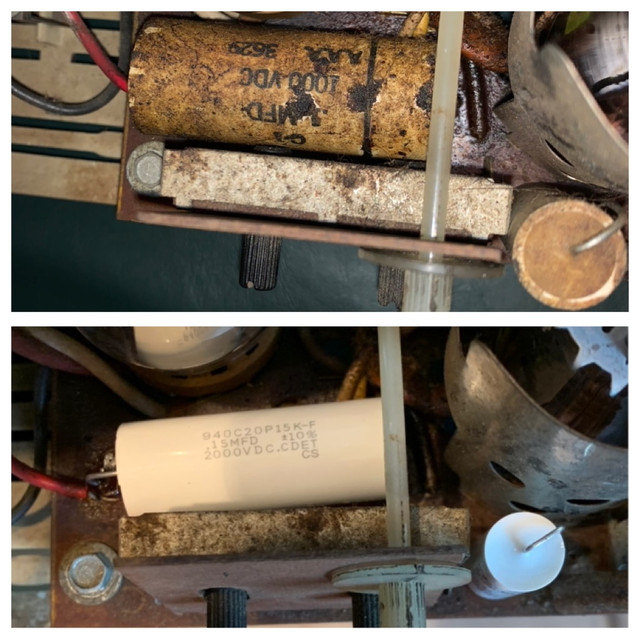 Picture: top is before, bottom is after
Capacitor C67
This capacitor is a decoupling/filter capacitor for the 670V boosted B+ power supply. It has to be able to tolerate 15khz ripple, and it sits right next to the power amplifier tube for horizontal sweep, so it has to tolerate lots of heat! The original capacitor is a paper in oil dielectric, and the 15khz ripple and the intense heat from the power amplifier tube slowly boil the oil out of the capacitor. This causes the dielectric's voltage rating to decrease bit by bit until the capacitor fails with a 400 volt short circuit.
A proper replacement should have a self-healing dielectric material that has a higher temperature rating. Also, the capacitor should have a smaller diameter, as the original capacitor's 20mm diameter has the capacitor almost touching the power amplifier tube's glass! Every millimeter smaller the diameter, the less heat transfer from the nearby vacuum tube. A higher voltage rating will also prolong life. Film capacitors have a life expectancy that is exponential in the magnitude of voltage derating. Finally, a
50% increase in capacitance for this capacitor will make the capacitor more effective at reducing ripple voltage (see before vs after below), without resulting in excessive surge current during the initial charging of the capacitor.
Before vs After:- Dielectric Type: "paper in oil" vs "metallized polypropylene"
- Capacitance: 0.11 mfd vs 0.15 mfd
- ESR: 16 ohms vs 10 ohms
- Voltage Rating: 1000 volts vs 2000 volts
- Temperature Rating: 85 celsius vs 105 celsius
- Diameter: 20 mm vs 17 mm
- Oscope Voltage Ripple peak-to-peak: 45.6 volts vs 33.6 volts
- New Part Number: Cornell Dubilier - CDE - 940C20P15K-F
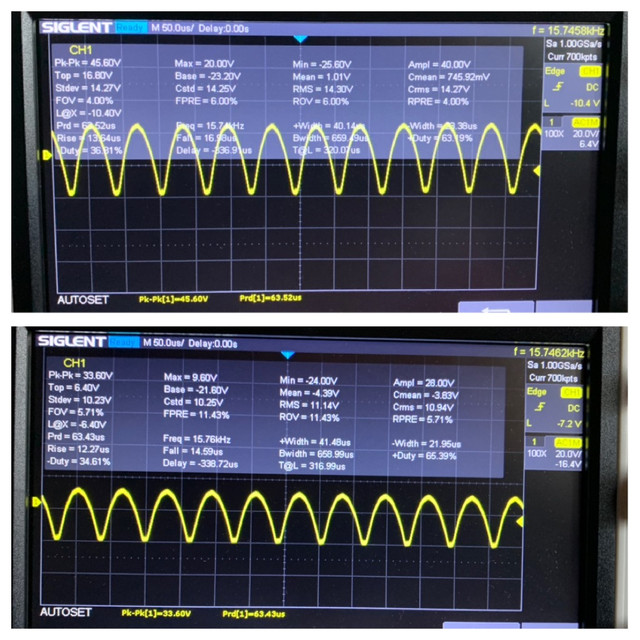 Picture: oscope of "Boosted B+ Voltage" top is before, bottom is after
Capacitor C105
This capacitor is a decoupling/filter capacitor for the B+ power supply. It is in parallel with capacitor C2, a 100 mfd electrolytic capacitor, but since the ESR of electrolytic capacitors is so high, they are only effective at reducing low frequency ripple such as rectified power outlet ripple of 60hz or 120hz. For TV and radio frequency ripple, a very low ESR capacitor is required. Increasing the capacitance by about 10x will more effectively reduce the high frequency ripple, and does not increase the surge current during power on to an unsafe level.
Before vs After:- Dielectric Type: "paper" vs "metallized polypropylene"
- Capacitance: 0.046 mfd vs 0.56 mfd
- ESR: 39 ohms vs 2 ohms
- Voltage Rating: 400 volts vs 400 volts
- Temperature Rating: 85 celsius vs 105 celsius
- Diameter: 14 mm vs 13 mm
- Oscope Voltage Ripple peak-to-peak: 3.88 volts vs 2.76 volts
- New Part Number: Cornell Dubilier - CDE - 930C4P56K-F
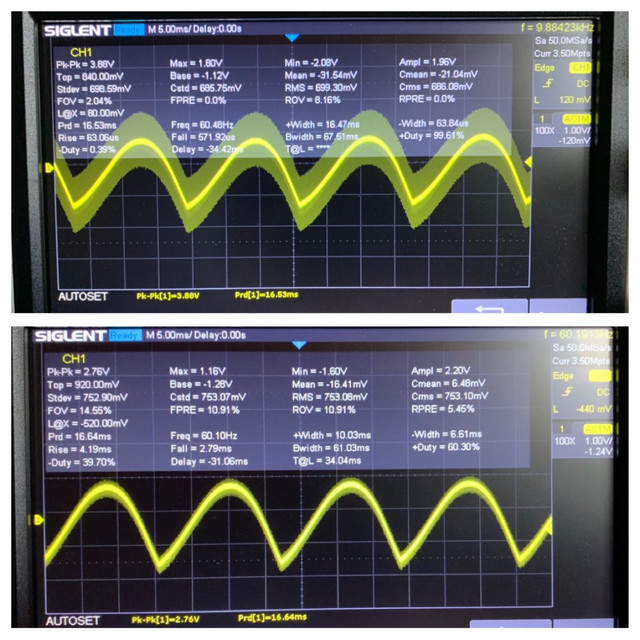 Picture: oscope of "B+ Voltage" top is before, bottom is after