Quote:
Originally Posted by Electronic M

Those are replacement tubes. Dirty little secret tube makers would rebadge their tubes for other TV and Radio OEMs that didn't own tube plants or didn't make a specific type. No maker the size of GE ever sold sets with other brand names on their tubes.
Though often rebadged tubes will have EIA numbers or foreign country of origin (in the case of the Philips of Holland made 6BQ5s in my Zenith Chancellor) stamped on them.
|
I am leaning towards keeping the spare NOS tubes in storage, until I get evidence that a tube needs to be replaced. I am amazed that just letting the TV warm up for a while and then tuning a bunch of pots, variable caps, and variable inductors was all it took for such an old TV to work reliably. Mild cathode poisoning in tubes and dielectric breakdown in electrolytic caps that have been without power for decades do need an initial extended period of "warming up". I noticed that with this TV, but now when I turn on the TV after it being off for several hours, it warms up very fast.
Question #1: I was expecting to have to replace many parts.
If the white colored foil and paper capacitors are working, do they need to be replaced preemptively to prevent catastrophic failure later on, or if they pass a visual inspection, ESR test, and capacitance, are they safe to keep in place?
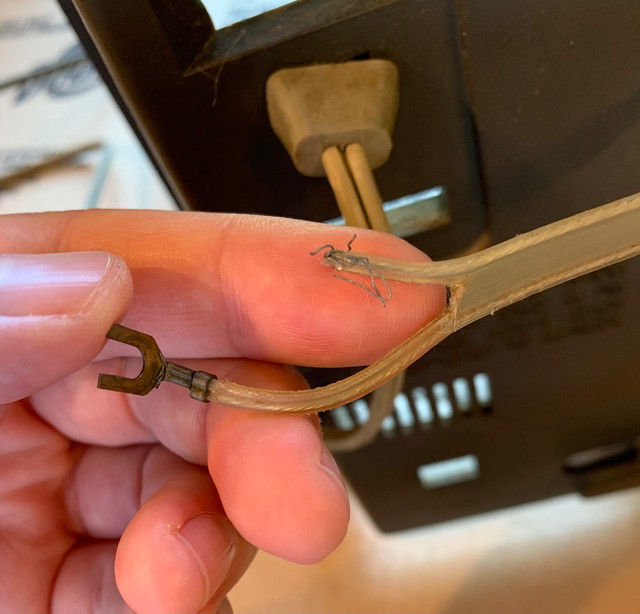 Question #2:
One of the previous owners of this TV ripped the spade lug off of the dipole antenna's wires. The wire length is about 6 inches, and the shortest replacement wires I can find online are 5 feet long!
Any idea where I can find a replacement part?
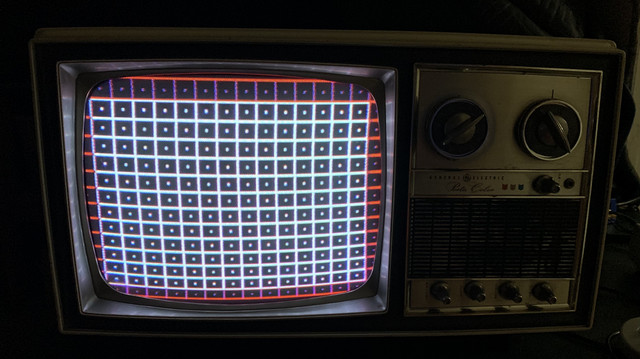
This grid test pattern shows 2 issues. Vertical linearity near the bottom is a bit squished, I need to spend some time playing with the pot for vertical linearity before asking questions about this.
Question #3: The red border of the test pattern is a bit purple at the top and bottom of the picture. The left and right red borders have the proper red color.
Is this a color purity issue or a convergence issue?
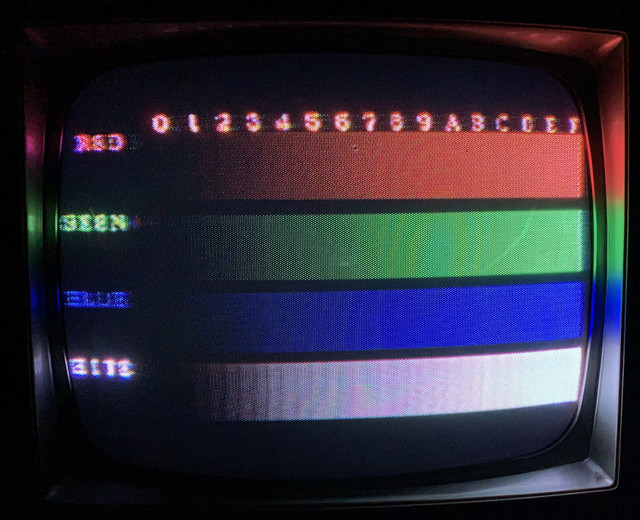
This color bars test pattern is great for tuning brightness and contrast for each color.
Question #4: If you zoom in to the letters for the words "RED" and "GREEN", you can see ghosting to the right of the letters "D" and "N". However, the letter "E" in the word "BLUE" does not have ghosting. The letters and numbers of the columns at the top of the picture also have similar ghosting. What is the potential cause of this?
What should I try/investigate to fix this?
Question #5: If you zoom into the red color bar in the area between columns "6" and "7" you can see a dead phosphor triad.
Is this repairable? Another dead phosphor triad can be seen in the red color bar in the area between the columns "A" and "B". I have heard of burned up bits of cathode flaking off and shorting the electron gun. Is it possible some burned bits of cathode have flaked off and blocked the cathode ray from hitting a few phosphor triads?
Question #6: The high amounts of "cooked" dust and filth inside the TV, the fact that vacuum tubes have been replaced decades ago, and the cosmetic wear and tear to the outside of the chassis all indicate that this TV has been heavily used.
So why does the CRT still output such a strong "bright" picture? Is the CRT model used in these known to have a very long life? I have seen many CRT TVs from the 1990s that have "gone dim" due to heavy usage.